Creativity Workshop for EPSRC NA-HPC Network

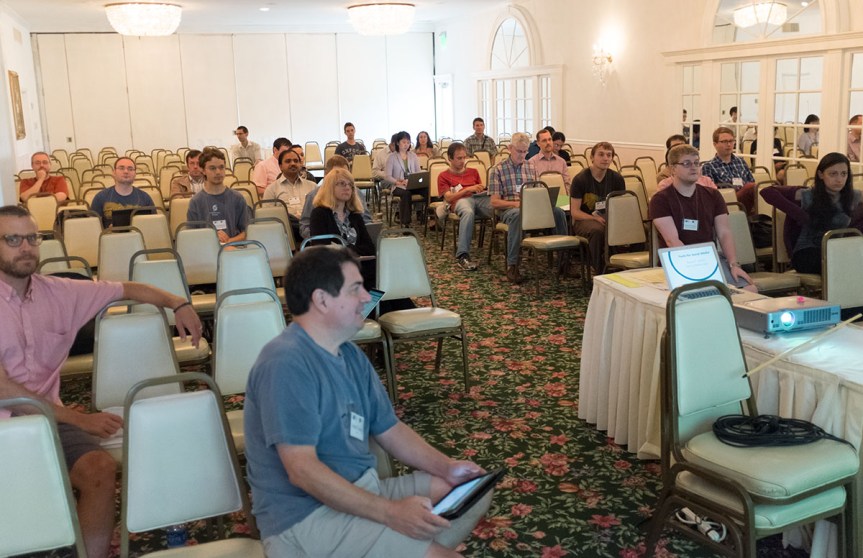
The EPSRC Network Numerical Algorithms and High Performance Computing, coordinated by David Silvester and me, came to the end of its three-year term in May 2014. One of our final activities was a two-day Creativity Workshop, held at Chicheley Hall just before Easter.
140416-1850-58-0780-Edit.jpg

The workshop was advertised to network members and we were able to accept all applicants. The 23 attendees comprised PhD students, postdoctoral researchers, faculty, and HPC support experts from Cambridge University, the University of Edinburgh, Imperial College, The University of Manchester, MIT, NAG Ltd., Queens University Belfast, STFC-RAL, UCL, and the University of Tennessee at Knoxville, along with an EPSRC representative.

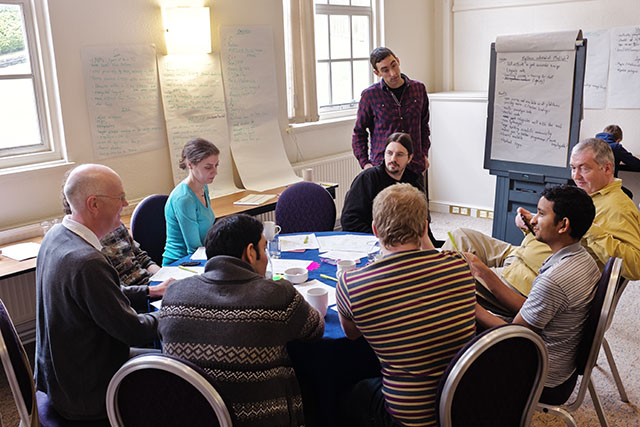
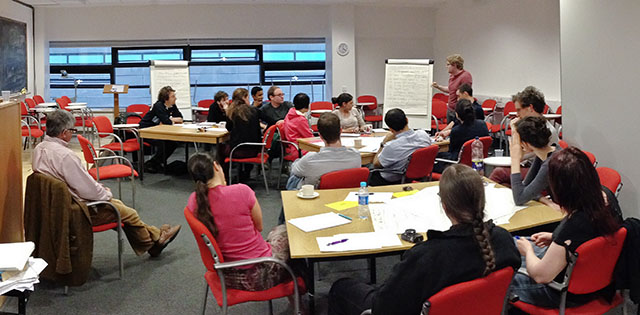
The workshop was facilitated by creativity expert Dennis Sherwood. I explained the idea of these workshops in an earlier post about a creativity workshop we held for the Manchester Numerical Analysis Group last year. The procedure is for the attendees to work in groups tackling important questions using a structured approach that encourages innovative ideas to be generated and carefully assessed and developed. The key ingredients are

  • a group of enthusiastic people,
  • careful planning to produce a set of nontrivial questions that address the workshop goals and are of interest to the attendees,
  • a willingness to adapt the schedule based on how the workshop progresses.
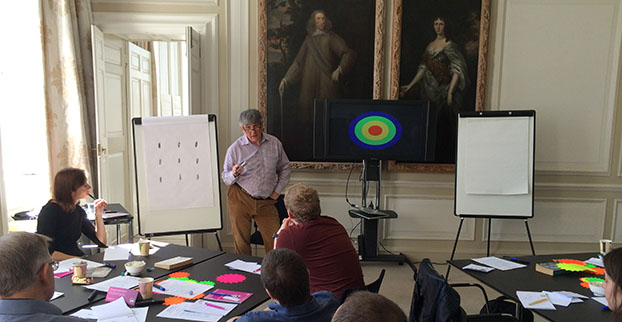
140416-1143-11-0766.jpg
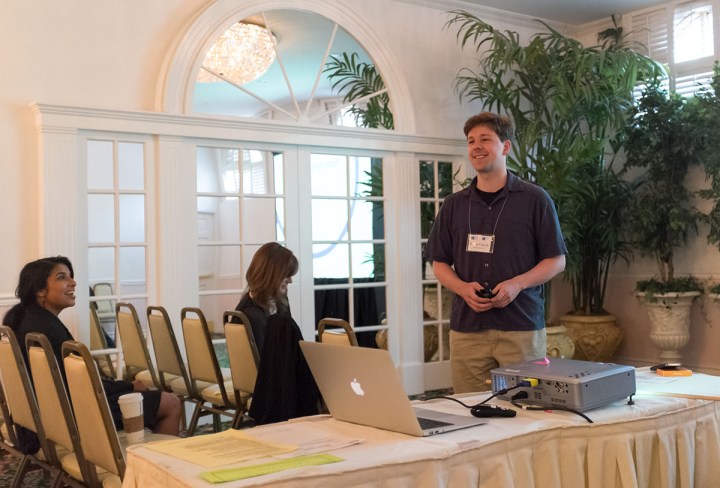
Dennis Sherwood talking about innovation and idea generation.

The workshop was targeted at researchers working at the interface between numerical analysis and high performance computing. The aims were to share ideas and experiences, make progress on research problems, and identify topics for research proposals and new collaborations.

The topics addressed by the groups were sensitivity in sparse matrix computations; programming languages; deployability, maintainability and reliability of software; fault-resilient numerical algorithms; and “16th April 2019”.

The notes for the last topic began “It’s 16th April 2019, and we’re celebrating the success of our network. What is it, precisely, that is so successful? And what was it about the decisions we took five years ago, in 2014, that, with hindsight, were so important?”. The discussion led to a number of ideas for taking the activities of the network forward over the coming years. These include

  • organizing summer schools,
  • producing a register of members’ interests and areas of expertise,
  • exploiting opportunities for co-design across communities such as algorithm designers, NA specialists and domain scientists, and
  • creating opportunities targeted at early career members of the network.

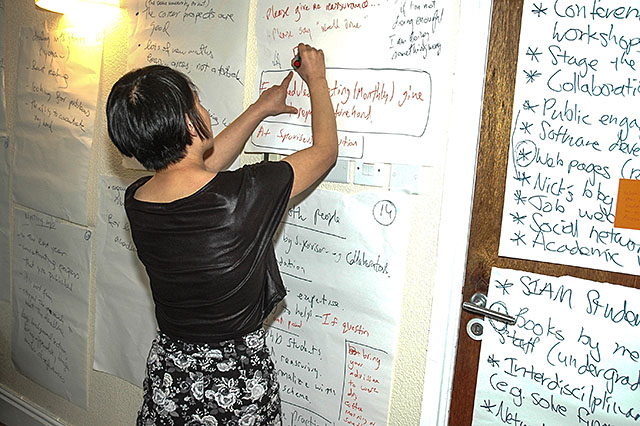
As an ice-breaker and a way of the participants getting to know each other everyone was asked to prepare a flip chart containing a summary of their key attributes, why they were attending, and something they have done that they feel particularly good about. These were presented throughout the two days.

140417-1648-04-0049.jpg
Presenting my “Who I Am”, with Post-its behind me containing ideas written down by participants during the workshop.

Dennis Sherwood has produced a 166-page report that distills and organizes the ideas generated during the workshop. Attendees will find this very useful as a reminder of the event and of the various actions that resulted from it.

The Venue
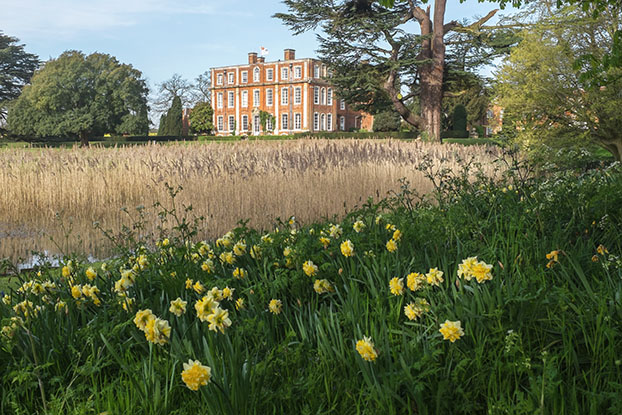
140417-0737-16-4240-Edit.jpg

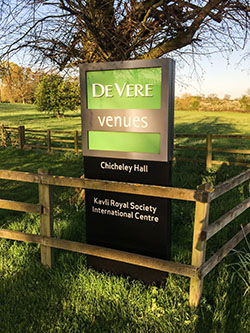
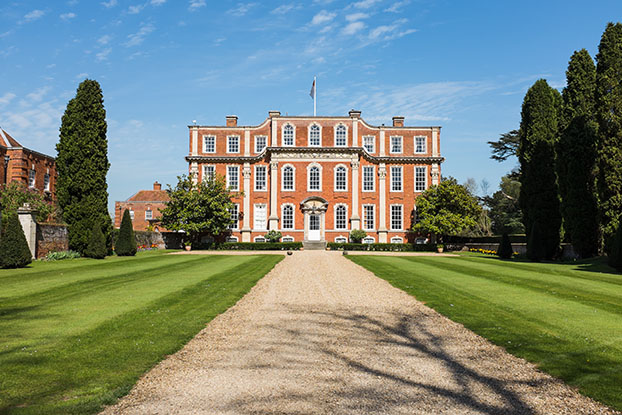
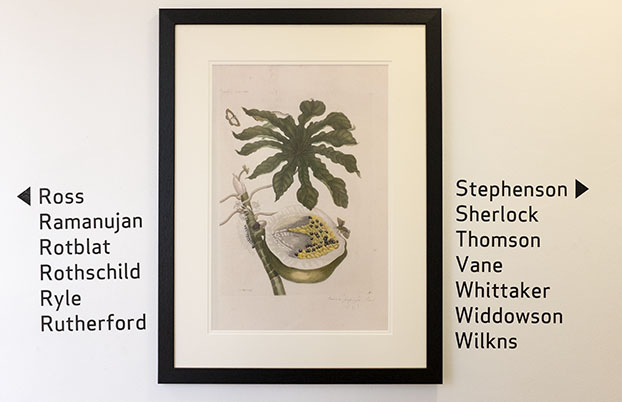
Chicheley Hall, is a historic country house located near Milton Keynes. It was purchased a few years go by the Royal Society, who turned it into a hotel and conference center, and it houses the Kavli Royal Society International Centre. It’s a terrific place to hold a small workshop. The main house and its meeting rooms have a wonderful ambience, the 80-acre grounds (complete with lake and dinosaur sculpture) are a delight to walk around, and each of the 48 bedrooms is named after a famous scientist.
140416-1236-23-4066.jpg

140416-1819-09-4147.jpg

Photo credits: Nick Higham (1,2,4,5,6), Dennis Sherwood (3).

Addendum (July 29, 2014)

Videos of Lectures from Gene Golub SIAM Summer School 2013

Videos of lectures given by four of the five lecturers at the 2013 Gene Golub SIAM summer school at Fudan University in Shanghai are now available on the summer school website.

These include the five 2-hour lectures from my course on Functions of Matrices. Here is a summary of the contents of my lectures, with direct links to the videos hosted on YouTube.

IMG_2444.JPG

  • Lecture 1: History, definitions and some applications of matrix functions. Quiz.
  • Lecture 2: Properties, more applications, Fréchet derivative, and condition number.
  • Lecture 3: Exponential integrator application. Problem classification. Methods for f(A): Schur-Parlett method, iterative methods for sign function and matrix square root.
  • Lecture 4: Convergence and stability of iterative methods for sign function and square root. The f(A)b problem. Software for matrix functions.
  • Lecture 5: The method of Al-Mohy and Higham (2011) for the \exp(A)b problem. Discussion of how to do research, reproducible research, workflow.
A written summary of the course is available as Matrix Functions: A Short Course (MIMS EPrint 2013.73).

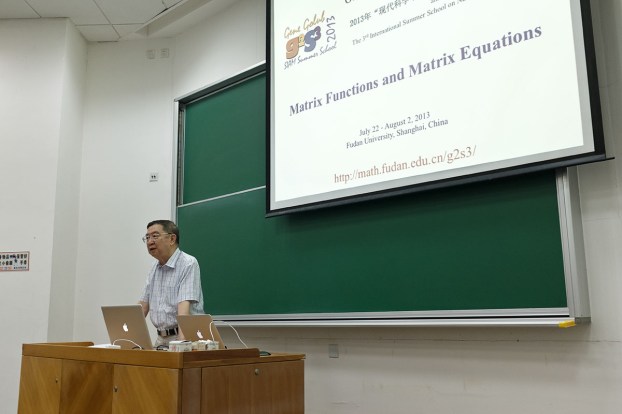
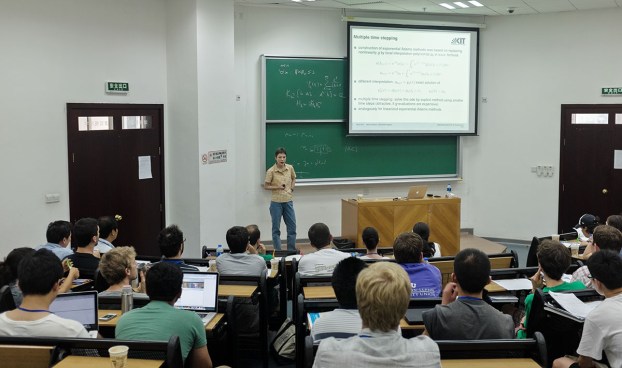
The video team, visible in the photo below that I took of my audience, have done a great job. The music over the opening sequence is reminiscent of the theme from the film Titanic!

130722-0829-58-2448.jpg

As a reminder, other relevant links are

Matrix Functions Course at Gene Golub SIAM Summer School 2013

As described in a previous blog post, I gave a course on matrix functions at the Gene Golub SIAM Summer School in Shanghai last July. Summer Schools are regularly held in Shanghai and it has been traditional to produce a booklet with summaries of the courses delivered. The organizers therefore asked the speakers at the Golub Summer School to provide a summary of their courses.

I have written a summary, jointly with my postdoctoral research associate Lijing Lin, who acted as TA for the course. It is available as Matrix Functions: A Short Course (MIMS EPrint 2013.73). You can also access the other materials for the course.

In 2005 I interviewed Gene Golub when he visited Manchester. A transcription of the interview is available as An Interview with Gene Golub (MIMS EPrint 2008.8).

If you didn’t have the chance to meet Gene the interview will give you some insight into his career and the early history of numerical linear algebra. Here is a photo of Gene that I took after the interview.

050703-1937-36.jpg
Gene Golub, July 2005 by Nick Higham.

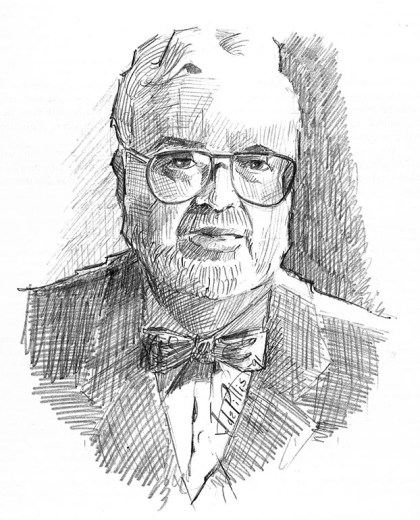
The sketch below is by John de Pillis, a Professor of Mathematics at the University of California, Riverside. John is a talented sketcher and cartoonist and his 777 Mathematical Conversation Starters is full of cartoons, stories, and quotes. It includes a quote from Gene:

Most problems in scientific computing eventually lead to solving a
matrix equation.

golub-1991.jpg
Gene Golub by John de Pillis, 1991.

Creativity Workshop

The Numerical Analysis Group at the University of Manchester held a two-day Creativity Workshop at Shrigley Hall in the Cheshire countryside at the end of May 2013. All of the numerical analysis staff, postdocs and PhD students attended, along with two external collaborators from NAG and the Rutherford Appleton Laboratory.

After successfully piloting creativity workshops in 2010 under the Creativity@Home banner, the Engineering and Physical Sciences Research Council (EPSRC) now encourages holders of large grants to exploit creativity training.

A creativity workshop is an event in which a group of people tackle questions using a structured approach that encourages innovative ideas to be generated and carefully assessed and developed. It avoids the trap that we readily fall into of evaluating ideas too soon. Such an event needs an experienced facilitator who understands the nature of creativity and can skillfully guide the participants through the steps of tackling problems.

We were fortunate to have as our guide Dennis Sherwood, a leading expert on creativity who has worked with a wide variety of organizations including Manchester United, the National Grid and the European Commission, and who is recommended by EPSRC (indeed Dennis previously led an EPSRC-funded creativity workshop in 2010 that I attended as part of the Manchester CICADA team).

130530-1200-59-1898.jpg

Dennis provides participants with a day of creativity training before a workshop. He quotes Koestler’s law (from The Act of Creation, 1964):

The creative act is not an act of creation in the sense of the Old Testament.
It does not create something out of nothing.
It uncovers, selects, reshuffles, combines, synthesizes, already
existing facts, ideas, faculties, skills.
The more familiar the parts the more striking the new whole.

He points out a problem with Koestler’s definition: it assumes that the sub-assemblies that are selected, reshuffled, and so on, are already explicitly there. In practice they are usually there within existing patterns, and may not be so obvious. He formulates Sherwood’s Law:

Creativity is the process of forming new patterns from pre-existing
component parts. The more the resulting pattern shows emergent
properties, such as those of beauty, utility, or value,
the more powerful the corresponding idea.

So creativity does not necessarily need new ideas (in any case, we usually don’t know if an idea is novel), but is about taking existing ideas and combining them in new and unanticipated ways. Dennis’s training days and his books 1, 2 explain the principles of creativity and the workshops themselves help put them into practice.

130530-1217-35-0324.jpg

At our workshop a number of questions were addressed, including “Being a magnet for talent”, “The undergraduate curriculum”, “Software and programming languages”, “The PhD experience”, as well as strategic plans for the group and plans for future research projects and grant proposals.

By the end of an exhausting workshop many ideas had been generated and assessed and the group is now planning the next steps with the help of the detailed 94-page written report produced by Dennis.

Despite some understandable initial skepticism among some attendees new to the creativity workshop concept, everyone participated fully and enjoyed the experience. I thoroughly recommend such a workshop to other research groups.

130530-1539-08-0335.jpg 130508-1619-34-2043.jpg

Photo credits: Nick Higham (1,4), Dennis Sherwood (2,3).

Footnotes:

1

D. Sherwood, 1998, Unlock Your Mind. A Practical Guide to Deliberate and Systematic Innovation. Gower Publishing Ltd., Aldershot, Hampshire, UK.

2

D. Sherwood, 2001, Smart Things to Know about Innovation and Creativity. Capstone, Oxford, UK.

Gene Golub SIAM Summer School 2013

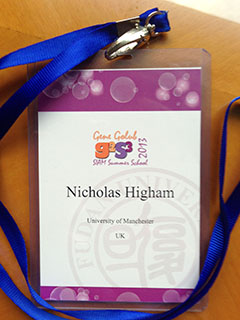
A two week Gene Golub SIAM summer school on matrix functions and matrix equations was held at Fudan University, Shanghai from July 22 to August 2, 2013, in conjunction with the 3rd International Summer School on Numerical Linear Algebra and the 9th Shanghai Summer School on Analysis and Numerics in Modern Sciences. This was the fourth Golub Summer School and the second devoted to numerical linear algebra.

45 PhD students attended, coming from institutions in 15 countries. The lecturers were me and Marlis Hochbruck (Karlsruhe Institute of Technology, Germany) in week 1 and Peter Benner (Max Planck Institute, Magdeburg), Ren-Cang Li (University of Texas, Arlington) and Xiaoye (Sherry) Li (Lawrence Berkeley National Laboratory, USA) in week 2.

My 10 hours of lectures were on matrix functions. The slides and exercises can be downloaded from my website.

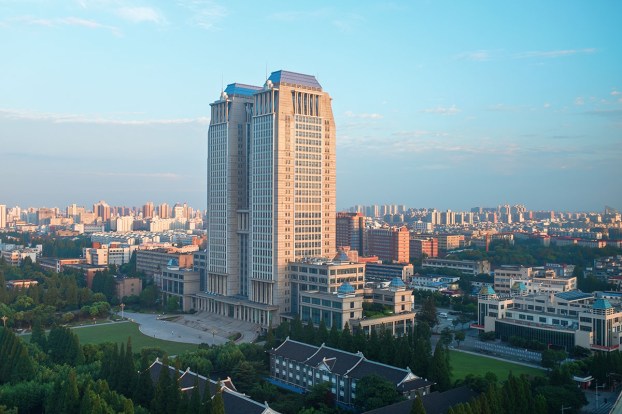
The lectures were held in the mornings in the GuangHua Twin Tower – an impressive, marbled 30-storey building on the Fudan campus. Attendees were grateful that the lecture room was air conditioned, as the Shanghai summer was at its peak of temperature and humidity, and on the Friday of the first week a record temperature of 40.6 degrees Celsius (105 degrees Fahrenheit) was reached in the city.

130721-2231-02_2450.jpg
The GuangHua Twin Tower from my room in the Fuxuan Hotel.

Afternoons contained exercise sessions, 10-minute presentations by the students on their thesis work, and a guest seminar by Hongguo Xu (University of Kansas) in week 1 and Heike Fassbender (TU Braunschweig) in week 2. These were fully attended and it was great to see the students working so enthusiastically together and interacting with the lecturers.

For the lunches and dinners the students and lecturers sat together in randomized positions – an excellent idea on the part of the local organizers which helped ensure that people got to know each other.

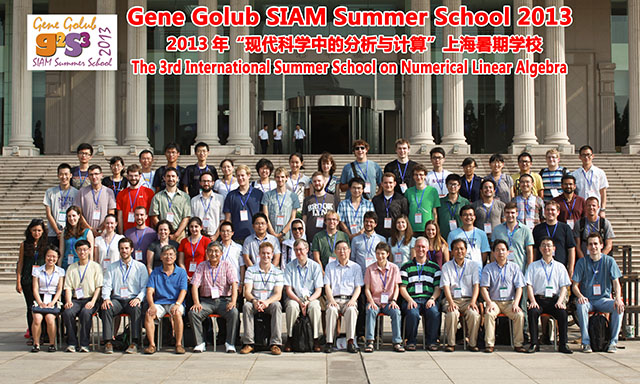
Group photos at conferences can be rather shambolic. This one was the most professional I’ve ever seen. When we arrived at the designated spot the photographer had already set up three rows of metal staging and the photo was quickly taken (just as well given the scorching heat even at 8.15 am). Laminated photos were delivered to participants the same afternoon.

130722-0823-41-66.jpg

The local organizers are to be congratulated on an excellent job. In particular, Weiguo Gao and Yangfeng Su (Fudan University) and Zhaojun Bai (UC Davis) were busy every day making sure that the event ran smoothly. Daniel Szyld (Temple University) must also be mentioned for his excellent work over the last 5 years in chairing the SIAM committee that manages the Gene Golub SIAM Summer School program.

The school was generously supported by the SIAM Gene Golub Summer School fund, the Shanghai Center for the Mathematical Sciences, ISFMA (Sino French Institute of Applied Mathematics), the NSF (USA) and NAG.

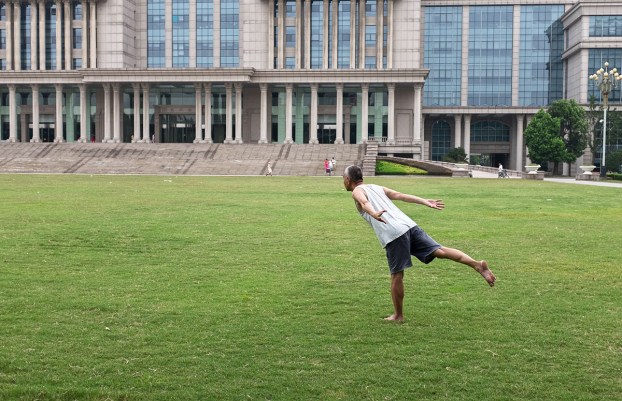
Three things will stand out in my memory from the School. First, the enthusiasm of the students, among whom will no doubt be some of the future leaders of our field. (See the blog post by my PhD student Sam Relton.) Second, sitting in the plush 15th floor cafe of the GuangHua Tower chatting to other participants over a cafe latte with smooth jazz coming over the speakers. Third, the Chinese (motor) cyclists, who carry a wondrous variety of goods on their bikes and ride without any attention to the traffic signals but miraculously seem to avoid accidents. See the photos below taken on the short walk from the hotel to the department!

In summing up I can do no better than to endorse Charlie Van Loan’s words in describing the first Gene Golub Summer School in 2010: “The idea of a summer school for graduate students from around the world is the perfect way to honor Gene’s memory. It is exactly the kind of activity that Gene loved to promote.”

130722-0106-26-2457.jpg
Professor Tatsien Li making welcoming remarks.
130726-0937-22-2706.jpg
Marlis Hochbruch.
130726-1523-54-2468.jpg
PhD student Antti Koskela (Innsbruck).
130726-1653-31-2475.jpg
Zhaojun Bai addressing the school.
130725-2334-52-2649.jpg
Morning callisthenics in front of the GuangHua Tower.

130722-2356-44-2532.jpg 130725-1125-24-2589.jpg 130725-1129-27-2593.jpg 130724-1133-29-2564.jpg 130725-1128-33-2591.jpg

Notes on SIAM Annual Meeting Minisymposium on Professional Use of Social Media

In my recent post I publicized the upcoming minisymposium Establishing a Professional Presence in the Online World: Unraveling the Mysteries of Social Media and More organized by Tammy Kolda and I at the 2013 SIAM Annual Meeting in San Diego.

We had an enjoyable session. Despite being in the most far flung and hard to find room on the site, we had a good-sized audience who contributed useful questions and thoughts.

The slides for the four talks are downloadable from the previous post. Here, I summarize a few key points from each talk.

Tammy Kolda (Sandia National Labs) described how to export BibTeX entries for journal articles to html via the JabRef reference manager. The resulting html includes an abstract, keywords, and hyperlinks to the DOI, a PDF file, an expurgated BibTeX entry and a preprint version (assuming all this information is present in the entry). The idea is that the html can be used for lists of publications on a web page. I haven’t used Jabref for a while, but intend to try this export filter out. Tammy also gave a flowchart answering the question of how and where to post a publication list.

130711-1900-37-2237.jpg
David Gleich

David Gleich (Purdue University) gave his presentation using Prezi, a cloud-based presentation tool that produces “multiscale” slides that zoom in and out. He surveyed the main social media tools and classified them into categories 1-1, 1-many and many-many. He then explained how he keeps on top of information using Flipboard, Feedly and Instapaper daily.

I described reasons for mathematicians to blog or tweet and the features that characterize a good blog. I also gave tips for using WordPress and Twitter and described SIAM’s plans for a SIAM blog.

130711-1936-40-2248.jpg
Nick Higham

Finally, Karthika Muthukumaraswamy (SIAM Public Awareness Officer) gave a compelling explanation of why mathematicians and scientists should blog and how the web is changing science communication. She also explained the benefits of blog networks, in which several people contribute to a blog, and the motivation for the planned SIAM blog.

130711-2001-09-2254.jpg
Karthika Muthukumaraswamy

130711-1900-13-2230.jpg

More photos are available in my photo gallery.

Finally, I note that David Bindel has written some notes on the SIAM Annual meeting.

SIAM Annual Meeting Minisymposium on Professional Use of Social Media

Tammy Kolda and I are organizing a minisymposium Establishing a Professional Presence in the Online World: Unraveling the Mysteries of Social Media and More at the 2013 SIAM Annual Meeting in San Diego.

This page will act as a repository for the slides of the talks, related information, and a place for discussion. It will be updated as necessary from the date of first post. (Edit: the titles now link to the final versions of the talks in PDF form.)

MS89: Thursday, July 11, 10:30 AM-12:30 PM in Garden Salon I

Abstract: I will discuss the importance of making your publications easily
available online and various ways to maintain such a list. We’ll discuss
important information to include (like DOIs), various websites that
maintain the lists for you, and tools for tracking and exporting your own
lists.

Abstract: I’ll describe my experiences using social media from the past
few years and some lessons. This will include a brief survey of the tools
out there my reasons for using Twitter and WordPress.

Abstract. I will discuss how and why social media can be useful for a
researcher, both as a consumer and a contributor, drawing on my own
experiences of using Twitter and blogging with WordPress. I will also
discuss how SIAM is using social media.

Abstract. I will discuss the importance of blogging for scientific
communication in general, and more specifically, why SIAM may be ready
for a community blog. Based on surveys SIAM has conducted, I will
discuss how a shared blog space can help address the many needs of the
SIAM community in terms of networking, collaboration, scientific
discussion, funding and outreach. More broadly, I will discuss the
importance of direct communication between scientists and the general
public, and how blogs can help achieve this.

Workshop on Matrix Functions and Matrix Equations

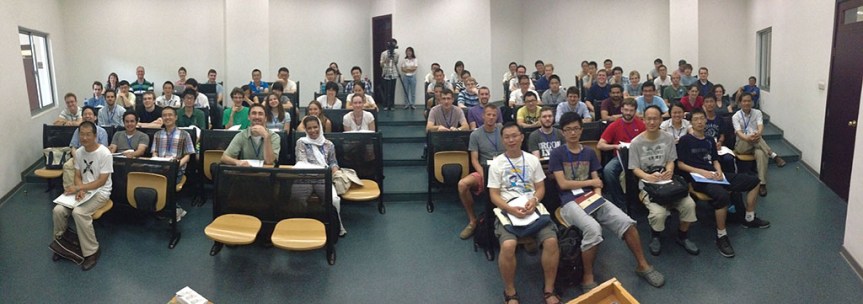
Last month we (Stefan Guettel, Nick Higham and Lijing Lin) organized a 2.5 day workshop Advances in Matrix Functions and Matrix Equations We had 57 attendees from around the world (see group photo): UK (19), Italy (7), USA (7), Germany (6), Canada (2), France (2), Portugal (2), South Africa(2), Saudi Arabia(2), Austria (1), Belgium (1), India (1), Ireland (1), Poland (1), Russia (1), Sweden (1), Switzerland (1).

We last organized a workshop on matrix functions in Manchester in 2008 (MIMS New Directions Workshop Functions of Matrices). The field has advanced significantly since then. Some emerging themes of this year’s workshop were as follows.

Krylov methods: Several speakers presented new results on this class of methods for the approximation of large-scale matrix functions, including a convergence analysis by Grimm of the extended Krylov subspace method taking into account smoothness properties of the starting vector, black-box parameter selection for the rational Krylov approximation of Markov matrix functions by Guettel and Knizhnerman, and an adaptive tangential interpolation strategy for MIMO model order reduction by Simoncini and Druskin.

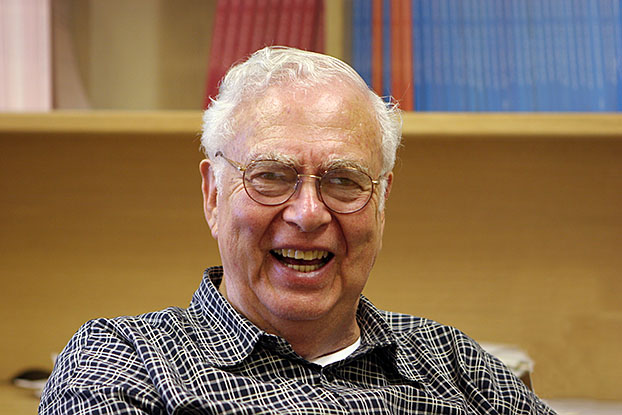
Matrix exponential: Research continues to focus on this, the most important of all matrix functions (the inverse is excluded as being too special). We were delighted that Charlie Van Loan opened the workshop with a talk “What Isn’t There To Learn from the Matrix Exponential?”. Charlie wrote some of the key early papers on exp(A). Indeed his work on exp(A) began when he was a postdoc at Manchester in the early 1970s, and his 1975 Manchester technical report A Study of the Matrix Exponential contains ideas that later appeared in his papers and his book (with Golub) Matrix Computations. In particular, it makes the case that “anything that the Jordan decomposition can do, the Schur decomposition can do better”, and is still worth reading.

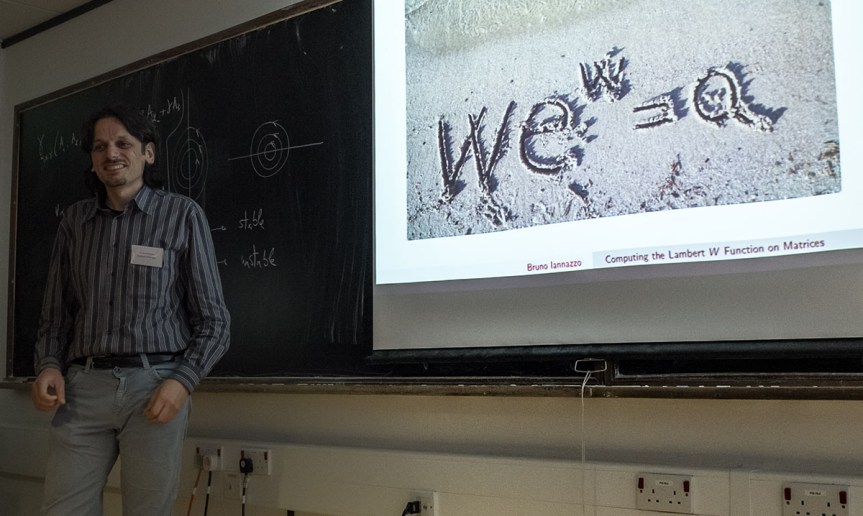
Exotic matrix functions: Two talks focused on newer, more “exotic” matrix functions and had links to Rob Corless, who was in the audience. Bruno Iannazzo discussed how to compute the Lambert W function of a matrix, which is any solution of the matrix equation X e^X = A. The scalar Lambert W function was named and popularized in a 1996 paper by Corless, Gonnet, Hare, Jeffrey and Knuth, On the Lambert W Function; it has many applications, including in delay differential equations. Bruno finished with a striking photo of the equation written in sand. images/130410-1058-06-0754.jpg Mary Aprahamian presented a new matrix function called the matrix unwinding function, defined as U(A) = (A - \log e^A )/(2\pi i), which arises from the scalar unwinding number introduced by Corless, Hare and Jeffrey in 1996. She showed that it is useful as a means for obtaining correct identities involving multivalued functions at matrix arguments, as well as being useful for argument reduction in evaluating the matrix exponential.

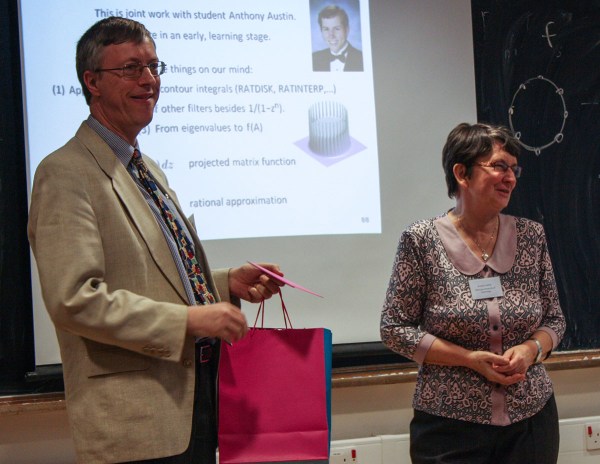
A special afternoon session celebrated the 70th birthday of Krystyna Zietak, who has made many contributions to numerical linear algebra and approximation theory. Krystyna gave the opening talk in which she described some highlights of her international travels and of hosting visitors in Wroclaw, well illustrated by photos.

images/130412-1255-30-2478.jpg
Happy birthday Krystyna!
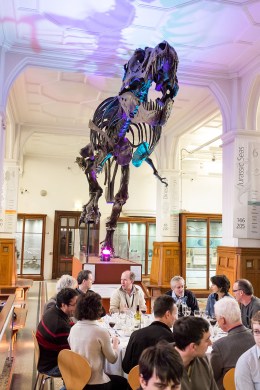
Following the session we had a reception in the Living Worlds gallery of the Manchester Museum, followed by a dinner in the Fossil gallery, with Stan the Tyrannosaurus Rex looking over us.

images/130411-1726-22-09341.jpg
Dinner in the Fossil gallery

Financial support for the workshop came from the European Research Council and book displays were kindly provided by Cambridge University Press, Oxford University Press, Princeton University Press and SIAM.

Most of the talks are available in PDF format from the workshop programme page.

A gallery of photos from the workshop has been produced, combining the efforts of several photographers.

SIAM Conference on Computational Science and Engineering 2013

As predicted in my my preview post, this conference, held on the Boston waterfront, proved to be SIAM’s largest ever, with 1378 attendees. Over 1000 presentations were given in up to 20 parallel minisymposia at a time, but this did mean that there was at least one talk (and usually several) of interest to me in almost every time slot.

One thing I learned from the conference is how widely Python is being used in computational science, especially for solving real world problems involving large amounts of data. This is partly due to its ability to act as the glue between codes written in other languages and web applications. The IPython environment, with its notebook interface, was featured in a number of talks, in some of which the slides were displayed using the notebook.

The following highly selective photos will give a flavour of the conference.

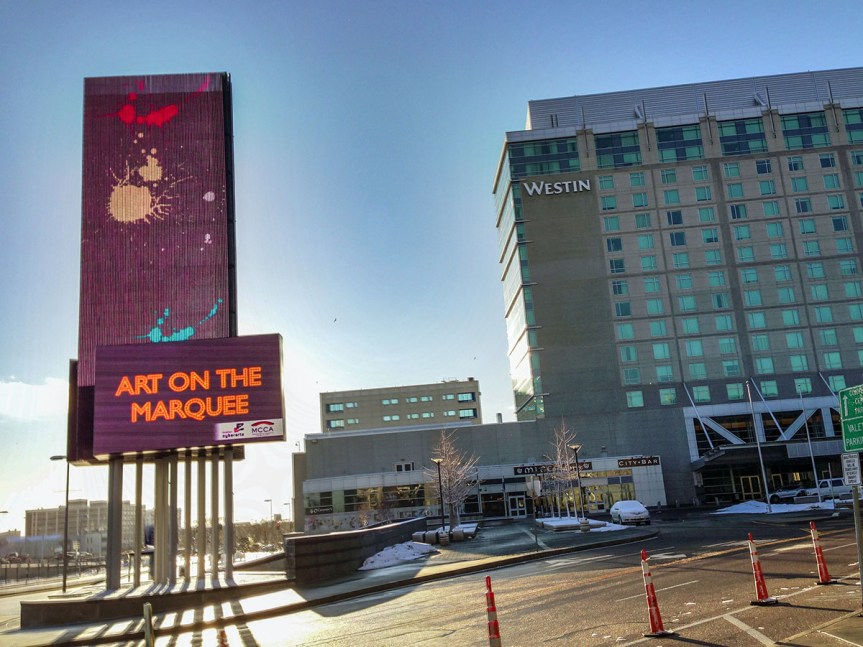
file://d:/dropbox/org/images/130225-0726-35-1605.jpg The conference venue. Note the residual snow, which fortunately did not fall in any serious amounts during the conference.
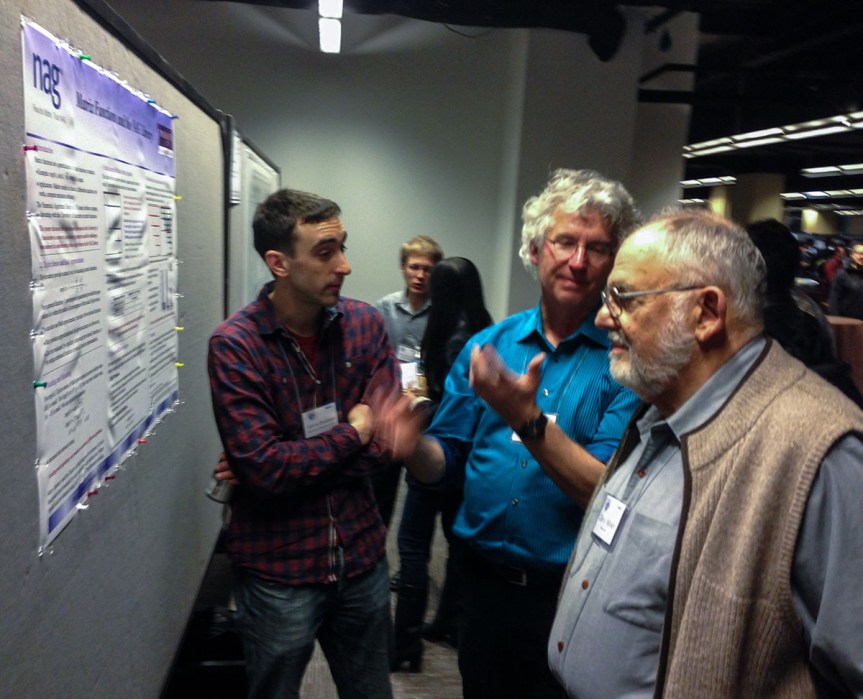
file://d:/dropbox/org/images/130226-2124-20-1630.jpg The poster session of about 65 posters was preceded by a poster blitz (1 minute presentations) and was accompanied by an excellent dessert. This photo shows Edvin Deadman (University of Manchester and NAG Ltd.) discussing his poster on Matrix Functions and the NAG Library with Cleve Moler and Charlie Van Loan (authors of the classic Nineteen Dubious Ways to Compute the Exponential of a Matrix paper). For some thoughts on poster sessions by one of the conference attendees see Please, no posters! by David Gleich.
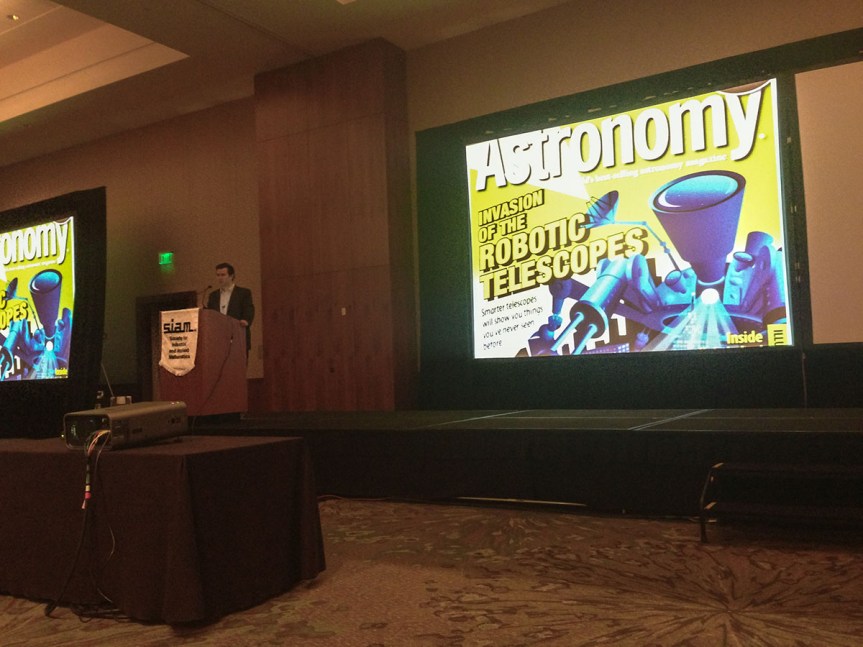
file://d:/dropbox/org/images/130227-1327-55-1690.jpg Josh Bloom’s (UC Berkeley) invited presentation Automated Astrophysics in the Big Data Era contained a fascinating mix of observational astronomy, machine learning, robotic telescopes, numerical linear algebra, and Python, with a focus on classifying stars.
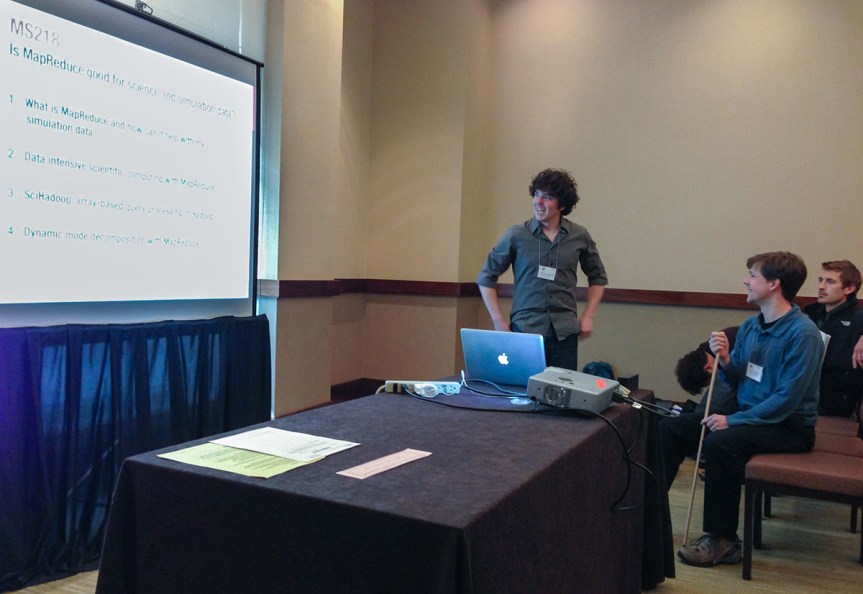
file://d:/dropbox/org/images/130228-1629-26-1706.jpg It was interesting to see MapReduce being used to implement numerical algorithms, notably in the minisymposium Is MapReduce Good for Science and Simulation Data? organized by Paul Constantine (Stanford; standing) and David Gleich (Purdue; sitting, with pointer).
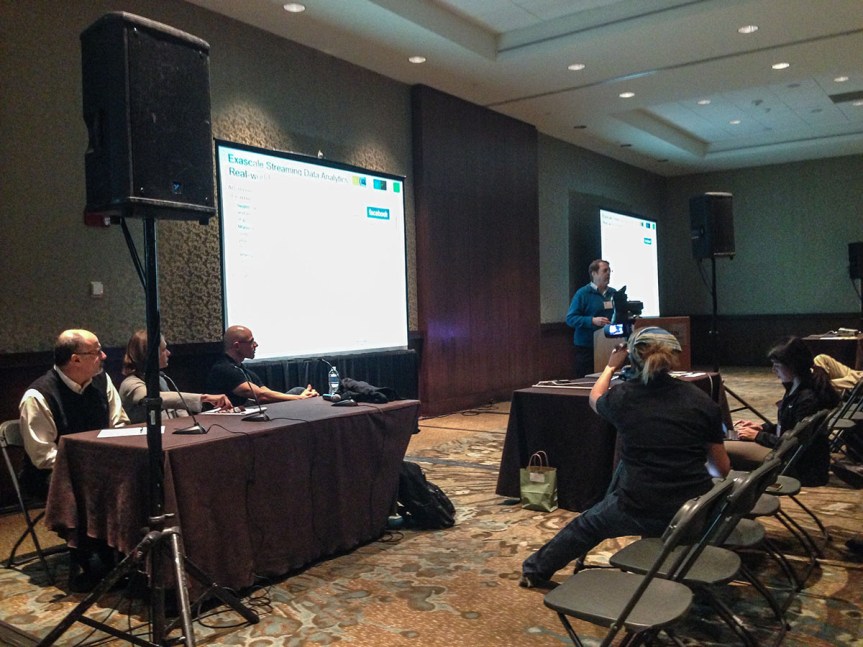
file://d:/dropbox/org/images/130227-1157-03-1678.jpg Here is the lunchtime panel Big Data Meets Big Models being videod. Highlights from this panel and some of the invited plenary talks will be available in due course on the SIAM Presents YouTube channel.

If you weren’t at the conference perhaps you can make it to the next one in two year’s time (date and location to be announced). In the meantime a good way to keep up with events is to join the SIAM Activity Group on Computational Science and Engineering, which organizes the conference.

SIAM Conference on Computational Science and Engineering 2013 Preview

I’ll be attending the SIAM CS&E meeting in Boston next week. This will be the first time I’ve attended this now biennial meeting, which has been running since 2000. The meeting is run by the SIAM Activity Group on Computational Science and Engineering, which is far and away SIAM’s largest activity group, with over 2000 members. The Boston conference is shaping up to be SIAM’s largest ever meeting (apart from ICIAM) with well over 1000 attendees.

The program, spread over five full days, shows the vitality of the field. I’ll be speaking on the first morning in the minisymposium Numerical Accuracy and Reliability Issues in High Performance Computing organized by Marc Baboulin and Ilse Ipsen. Unfortunately there are at least two other minisymposia that I’d like to attend at the same time!

If you are not able to attend you can get a feel for what’s going on by following the hashtag #SIAMCSE13 on Twitter. Also watch out for some live blogging of minisymposia from Paul Constantine and David Gleich; I may even have a go at this myself.