Hans Schneider (1927–2014)

I first met Hans in 1984 at the Gatlinburg meeting IX in Waterloo, Canada, at which time I was a PhD student. When I discussed my work on matrix square roots with him he recalled a 1966 paper by Culver “On the Existence and Uniqueness of the Real Logarithm of a Matrix”, of which I was unaware. By the time I returned to Manchester, after visiting Stanford for a few weeks, a copy of the paper was waiting for me, with an explanation of how the results of that paper could be adapted to analyze real square roots of a real matrix.

As chair of the 2002 Householder symposium XV in Peebles, Scotland, I was delighted to invite Hans to deliver the after-dinner speech. (The Gatlinburg meeting was renamed the Householder symposium in 1990, in honour of Alston Householder, who organized the early meetings.) Having Hans speak was particularly appropriate as he had studied at the nearby University of Edinburgh. I believe this was the last Householder Symposium that Hans attended.

I kept a copy of my introduction of Hans at the banquet. It seems appropriate to reproduce it here.

Ladies and gentlemen, our after-dinner speaker this evening is Hans Schneider, who is James Joseph Sylvester Emeritus Professor of Mathematics at the University of Wisconsin.

There’s an old definition that an intellectual is somebody who can hear the William Tell overture and not think of the Lone Ranger. I don’t think there are many people who can hear the term “linear algebra and its applications” and not think of Hans Schneider. After all, Hans has been Editor-in-Chief of the journal of that name since 1972, and developed it into a major mathematics journal. Hans was also instrumental in the foundation of the International Linear Algebra Society, of which he served as President from 1987 to 1996.

Some of you may be surprised to know that Hans has a strong connection with Scotland. He studied here and received his Ph.D. at Edinburgh University in 1952 under the famous Alexander Craig Aitken. I understand that Aitken gave him two words of advice: “Read Frobenius!”.

Well, it’s a real pleasure to introduce Hans and to ask him to speak on “The Debt Linear Algebra Owes Helmut Wielandt”.

The reference to Frobenius is apposite, given my original conversation with Hans since, as I have only recently discovered, Frobenius gave one of the earliest proofs of the existence of matrix square roots in 1896. That result, and much more about Frobenius’s wide range of contributions to mathematics is discussed in a 2013 book by Thomas Hawkins, The Mathematics of Frobenius in Context. A Journey Through 18th to 20th Century Mathematics (of which my copy has the rare error of having the odd pages on the left, rather than the right, of each two-page spread).

The photo below was taken during Hans’s after-dinner speech (more photos from the meeting are available in this gallery).
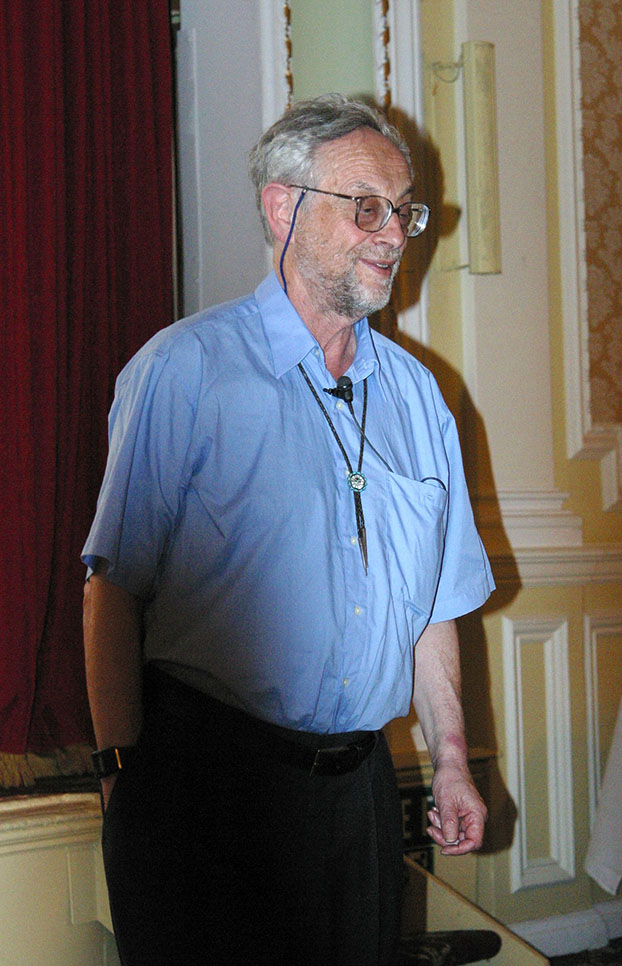
020619-2159-45.jpg

Links:

The Life of James Joseph Sylvester

Following my previous post about the James Joseph Sylvester Bicentenary and my article Sylvester’s Influence on Applied Mathematics I now give a brief, very selective, overview of Sylvester’s life. Some of this material was used in an after-dinner speech that I gave at the Householder Symposium XIX on Numerical Linear Algebra at Spa, Belgium on June 11, 2014.

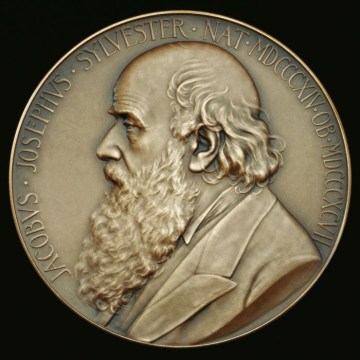
sylvester-medal-front.jpg
The Sylvester Medal of the Royal Society.

I’ve drawn on many sources for this post, but the most important is the 2006 biography by Karen Parshall, James Joseph Sylvester. Jewish Mathematician in a Victorian World. That title brings out two key points: that Sylvester was Jewish, which hindered his career, as we will see, and that he lived much of his life in Victorian England, when almost everything that today we take for granted when doing our research did not exist.

Thumbnail Sketch of The Man

Sylvester was born in London in 1814. He was short, mercurial, absent-minded, temperamental, fluent in French, German, Italian, Latin and Greek, and loved poetry but was not very good at it. He was a man of remarkable tenacity, as his career on both sides of the Atlantic shows.

Career Outline

I’ll give a brief outline of Sylvester’s unusual career, with its many ups and downs, then go on to discuss some specific events in his life.

First Spell in UK

  • Sylvester was a student at University College London (UCL) under De Morgan, age 14. He was withdrawn by his family after attempting to stab a fellow pupil.
  • He was a student at Cambridge, but was not able to take the degree because he was Jewish.
  • He held the chair of natural philosophy at University College London (UCL) for three years.

First Sojourn in USA

Sylvester became Professor of Mathematics at the University of Virginia in 1841. He left after four months after an altercation with an unruly student, because he was felt that the faculty did not back him up in a subsequent inquiry.

While in New York he applied for a position at Columbia University. According to R. L. Cooke (quoted in James Joseph Sylvester. Life and Work in Letters)

After leaving Virginia he sought a position at Columbia University, with a recommendation from one of America’s leading scientists, Joseph Henry. In a wonderful irony … the selection committee informed him that his rejection was in no way connected with the fact that he was British, only the fact that he was Jewish.

Rest of Career (age 29–).

  • Sylvester Worked for the next decade as an actuary for the Equity and Law Life Assurance Society in London and trained for the Bar. He founded the Institute of Actuaries. This is when he met Cayley, who became his best friend. For this ten-year period he was doing mathematics in his spare time.
  • He was appointed Chair at the Royal Military Academy, Woolwich and spent 15 years there.
  • He was appointed Chair at the newly founded Johns Hopkins University, Baltimore, at the age of 61. He negotiated a salary of $5000 payable in gold, plus an annual housing allowance of $1000 also payable in gold.
  • His final position was as the Savilian Professor of Geometry at New College, Oxford in 1883, which he took up at the age of 69.

The Neologist

Sylvester introduced many terms that are still in use today, including matrix (1850), canonical form (1851), Hessian (1851), and Jacobian (1852). Another notable example is the term latent root, which Sylvester introduced in 1883, with two charming similes:

“It will be convenient to introduce here a notion (which plays a conspicuous part in my new theory of multiple algebra), namely that of the latent roots of a matrix—latent in a somewhat similar sense as vapour may be said to be latent in water or smoke in a tobacco-leaf.”

The term has fallen out of use in linear algebra and matrix theory, but it can still be found in use through “the latent root criterion” in, for example (to pick two articles found with a Google search) Differentiating with brand personality in economy hotel segment in Journal of Vacation Marketing (2014) and GHOSTS: A travel barrier to tourism recovery in Annals of tourism research (2011).

Editor

Sylvester did a great deal of editorial work. He was an editor of the Quarterly Journal of Mathematics for 23 years. He founded the American Journal of Mathematics in 1878 when he was at Johns Hopkins University. This was the first mathematics research journal in the USA, and indeed Sylvester set up the first mathematics research department in the country. As Editor-in-Chief he experienced some of the problems that subsequent journal editors have suffered from.

  • He had to work very hard to secure high quality contributions, e.g., from his friend Cayley and from students and colleagues at Johns Hopkins, in addition to his own papers.
  • He solicited Alfred Kempe’s proof of the four color theorem. After Sylvester had accepted the paper his managing editor, William Story, realized there was a gap in the reasoning, due to overlooked cases, and wrote a note the accompany the paper in which he unsuccessfully tried to patch the proof. This all happened while Sylvester was in England and he was very unhappy with the incident.

Author

Even though Sylvester was an editor himself, he was also the author from hell! He was notorious for what his biographer Parshall calls “an impatience with bibliographic research”—something that led him into disputes with other mathematicians.

MacFarlane states that

Sylvester never wrote a paper without foot-notes, appendices, supplements; and the alterations and corrections in his proofs were such that the printers found their task well-nigh impossible. … Sylvester read only what had an immediate bearing on his own researches, and did little, if any, work as a referee.

The title of one particular paper illustrates this point:

J. J. Sylvester, Explanation of the Coincidence of a Theorem Given by Mr
Sylvester in the December Number of This Journal, With One Stated by
Professor Donkin in the June Number of the Same, Philosophical Magazine
(Fourth Series) 1, 44-46, 1851

Secular Equation Paper

Out of Sylvester’s hundreds of papers, one in particular stands out as notable to me: “On the Equation to the Secular Inequalities in the Planetary Theory”, Philosophical Magazine 16, 267-269, 1883, for the following reasons.

  • The title has virtually nothing to do with the paper.
  • This is the paper in which Sylvester defines the term latent roots—but as if a totally new concept, even though the concept of matrix eigenvalue was already known.
  • He states a theorem about a sum of products of latent roots of a product AB being expressible in terms of sums of products of minors of A and B.
  • He gives the first general definition of function of a matrix (later refined by Buchheim).
  • He discusses the special case of pth roots.

The paper is short (3 pages), no proper introduction is given to these concepts, and no proofs are given. In short, a brilliant but infuriating paper!

Baltimore Summer

In these days of ubiquitous air conditioning it is interesting to note one of the things that made it difficult for Sylvester to do research. Parshall writes, of Sylvester in Baltimore,

“He could not concentrate on his research on matrices in the debilitating summer heat and humidity”.

Teaching

Sylvester’s enthusiasm for matrices is illustrated by his attempt to teach the theory of substitutions out of a new book by Netto. Sylvester

“lectured about three times, following the text closely and stopping sharp at the end of the hour. Then he began to think about matrices again. `I must give one lecture a week on those,’ he said. He could not confine himself to the hour, nor to the one lecture a week. Two weeks were passed, and Netto was forgotten entirely and never mentioned again.” (Parshall, p. 271, quoting Ellery W. Davis).

Compare this with the following quote about E. T. Bell (famous for his book Men of Mathematics, 1937), from Constance Reid’s book about Bell:

Bell’s method of teaching was to read a sentence aloud and announce that he didn’t believe it. `By the time we students convinced him that it was true,’ concedes Highberg, `we pretty well understood it ourselves.’

Inaugural Lecture at Oxford, 12 December 1885

There are many ways in which we are more fortunate today than mathematicians of Sylvester’s time. But there were some advantages to those times. From his inaugural lecture, published as On the Method of Reciprocants as Containing an Exhaustive Theory of the Singularities of Curves (Nature, 1886)

It is now two years and seven days since a message by the Atlantic cable containing the single word “elected” reached me in Baltimore informing me that I had been appointed Savilian Professor of Geometry in Oxford, so that for three weeks I was in the unique position of filling the post and drawing the pay of Professor of Mathematics in each of two Universities:

Obstinacy

Emile Picard recounted how Sylvester, on a visit to Paris, asked him if in six weeks he could learn the theory of elliptic functions. Picard said yes, so Sylvester asked if a young geometer could be assigned to give him lessons several times per week. This began, but from the second lesson reciprocants and matrices started to compete with elliptic functions and in the ensuing several lessons Sylvester taught the young geometer about his latest research and they remained on that topic.

What Can We Learn from Sylvester’s Life?

If I had to draw two pieces of advice from Sylvester’s life story I would choose the following.

  • You are never too old to take on a major challenge (he took up the chair at Johns Hopkins University at the age of 61).
  • If you want to be remembered, define some new terms and have some theorems named after you!

James Joseph Sylvester (1814–1897) Bicentenary

This year (or more precisely September 3, 2014) is the bicentenary of the birth of James Joseph Sylvester, FRS, a prolific 19th century mathematician who led an eventful life, holding positions at five academic institutions, two of them in the USA.

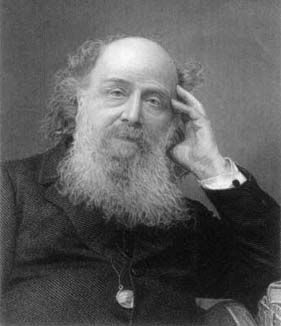
sylvester.jpg

My article Sylvester’s Influence on Applied Mathematics published in the August 2014 issue of Mathematics Today explains how Sylvester’s work continues to have a strong influence on mathematics. A version of the article with an extended bibliography containing additional historical references is available as a MIMS EPrint.

In the article I discuss how

  • Many mathematical terms coined by Sylvester are still in use today, such as the words “matrix” and “Jacobian”.
  • The Sylvester equation AX + XB = C and the quadratic matrix equation AX^2 + BX + C = 0 that he studied have many modern applications and are the subject of ongoing research.
  • Sylvester’s law of inertia, as taught in undergraduate linear algebra courses, continues to be a useful tool.
  • Sylvester gave the first definition of a function of a matrix, the study of which has in recent years has become a very active area of research.
  • Sylvester’s resultant matrix, which provides information about the common roots of two polynomials, has important applications in computational geometry and symbolic algebra.

Sylvester’s collected works, totalling almost 3000 pages, are freely available online and are well worth perusing: Volume 1, Volume 2, Volume 3, Volume 4.

In a subsequent post I will write about Sylvester’s life.

David Broomhead (1950–2014)

David Broomhead passed away on July 24th, 2014 after a long illness. David was a Professor of Applied Mathematics in the School of Mathematics at the University of Manchester. I got to know him in 2004 when the Victoria University of Manchester merged with UMIST and the two mathematics departments, his at UMIST and mine at VUM, became one.

080630-1614-10-3476-cropped.jpg

David was a truly interdisciplinary mathematician and led the CICADA (Centre for Interdisciplinary Computational and Dynamical Analysis) project (2007-2011), a £3M centre funded by the University of Manchester and EPSRC, which explored new mathematical and computational methods for analyzing hybrid systems and asynchronous systems and developed adaptive control methods for these systems. The centre involved academics from the Schools of Mathematics, Computer Science, and Electrical and Electronic Engineering, along with four PhD students and six postdocs, all brought together by David’s inspirational leadership.

One of the legacies of CICADA is the burgeoning activity in Tropical Mathematics, which straddles the pure and applied mathematics groups in Manchester, and whose weekly seminars David managed to attend regularly until shortly before his death. Indeed one of David’s last papers is his Algebraic approach to time borrowing (2013), with Steve Furber and Marianne Johnson, which uses max-plus algebra to study an algorithmic approach to time borrowing in digital hardware.

Among the other things that David pioneered in the School, two stand out for me. First, he ran one of the EPSRC creativity workshop pilots in 2010 under the Creativity@Home banner, for the CICADA project team. The report from that workshop contains a limerick, which I remember David composing and reading out on the first morning:

One who works on Project CICADA

Has to be a conceptual trader

Who needs the theory of Morse

To tap into the Force –

A mathematically driven Darth Vader!

The workshop was influential in guiding the subsequent activities of CICADA and its success encouraged me to organize two further creativity workshops, for the numerical analysis group and for the EPSRC NA-HPC Network.

101103-1804-12-0158-cropped.jpg
At the CICADA Creativity Workshop, November 2010.

The second idea that David introduced to the School was the role of a technology translator. He had organized (with David Abrahams) a European Study Group with Industry in Manchester in 2005 and saw first-hand the important role played by technology translators in providing two-way communication between mathematicians and industry. David secured funding from the University’s EPSRC Knowledge Transfer Account and combined this with CICADA funds to create a technology translator post in the School of Mathematics. That role was very successful and the holder (Dr Geoff Evatt) is now a permanent lecturer in the School.

I’ve touched on just a few of David’s many contributions. I am sure other tributes to David will appear, and I will try to keep a record at the end of this post.

Photo credits: Nick Higham (1), Dennis Sherwood (2).

Updates: Reminiscences and Obituaries

The Lanczos Tapes

file://d:/dropbox/org/images/lanczos07.jpg
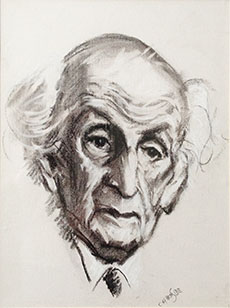
Charcoal sketch of Cornelius Lanczos by John Chirnside of UMIST.

Cornelius Lanczos (1893-1974) gave lectures at UMIST (a predecessor institution of The University of Manchester) in the late 1960s and early 1970s, while he was a Professor at the Dublin Institute for Advanced Study. In 1972, UMIST Audio Visual Services made three video recordings lasting almost three hours of Lanczos talking about mathematics, his life, and Einstein. In two of the tapes he is speaking in a group discussion, while in the other he speaks eloquently about his life for 50 minutes, directly to camera and apparently without notes. The topics he covers include his experiences as

  • student of Eötvös and Fejér in Hungary,
  • theoretical physicist,
  • assistant of Albert Einstein in Germany,
  • numerical analyst and inventor of the tau method,
  • (re-)discoverer of the fast Fourier transform and singular value decomposition,
  • inventor of the Lanczos algorithm while working at the US National Bureau of Standards, and
  • head of the Theoretical Physics Department at the Dublin Institute for Advanced Study.

The charcoal sketch above hung for many years in the office of the administrator of the mathematics department at UMIST and now has pride of place on the wall in my office in the Alan Turing Building.

My colleague Stefan Güttel has produced a version of the videos with bookmarks linking to the main topics of discussion. We are pleased to make the videos available online on the occasion of the 120th anniversary of Cornelius Lanczos’s birth (February 2, 1893).

file://d:/dropbox/org/images/lanczos01.jpg
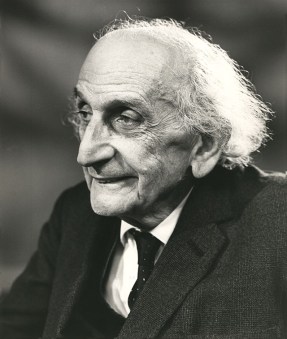
Cornelius Lanczos

Arthur Buchheim (1859-1888)

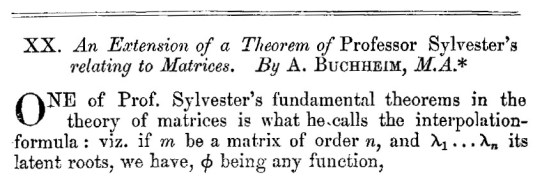
The new second edition of Horn and Johnson’s Matrix Analysis, about which I wrote in a previous post, includes in Problem 2.4.P2 a proof of the Cayley-Hamilton theorem that is valid for matrices with elements from a commutative ring and does not rely on the existence of eigenvalues. The proof is attributed to an 1883 paper by Arthur Buchheim.

A few years ago Arthur Buchheim’s work came up in my own investigations into the history of matrix functions and I discovered that he was a mathematics teacher at Manchester Grammar School, which is located a couple of miles south of the University of Manchester, where I work.

In 1884 Buchheim gave a derivation of Sylvester’s polynomial interpolation formula for matrix functions. The original formula was valid only for matrices with distinct eigenvalues, but in 1886 Buchheim generalized it to handle multiple eigenvalues using Hermite interpolation.

file://d:/dropbox/org/images/buch86-title.jpg

Appropriately, Rinehart, in his 1955 paper The Equivalence of Definitions of a Matric Function, cited Buchheim when he wrote

“there have been proposed in the literature since 1880 eight distinct definitions of a matric function, by Weyr, Sylvester and Buchheim, Giorgi, Cartan, Fantappiè;, Cipolla, Schwerdtfeger and Richter … All of the definitions except those of Weyr and Cipolla are essentially equivalent.”

Buchheim studied at New College, Oxford, under the Savilian Professor of Geometry, Henry Smith, and then at Leipzig under Felix Klein. Then he spent five years at Manchester Grammar School, from which he resigned due to ill-health the year before his death.

In addition to his work on matrix functions and the Cayley-Hamilton theorem, Buchheim published a series of papers promoting Grassmann’s methods. In his A History of Mathematics (1909), Cajori notes that

“Arthur Buchheim of Manchester (1859-1888), showed that Grassmann’s Ausdehnungslehre supplies all the necessary materials for a simple calculus of screws in elliptic space.”

He goes on to say that

“Horace Lamb applied the theory of screws to the question of the steady motion of any solid in a fluid.”

thus bringing in another, much more famous, Manchester mathematician about whom I recently wrote.

Sylvester wrote an obituary in Nature in which he stated “I … know and value highly his contributions to the great subject which engaged the principal part of my own attention during the transition period between my residence in Baltimore and at Oxford”.

The best source of information on Buchheim is an article

Jim Tattersall, Arthur Buchheim: Mathematician of Great Promise, in Proceedings of the Canadian Society for History and Philosophy of Mathematics Thirty-first Annual Meeting, Antonella Cupillari, ed, 18 (2005), 200-208.

which lists lists 24 papers that Buchheim published in his short life of 29 years.

Horace Lamb Portrait in Alan Turing Building

A portrait of Sir Horace Lamb (1849-1934), FRS, Beyer Professor of Pure and Applied Mathematics from 1888 to 1920, is on display on the Atrium bridge of the Alan Turing building in the School of Mathematics at the University of Manchester.

file://d:/dropbox/org/images/121031-1010-28_0595.jpg

This is the School’s common room, where we meet for morning coffee and lunch and which is the focal point of the School.

The 1913 portrait, approximately, 4 feet by 4 feet, is by Lamb’s son, Henry Lamb, a distinguished painter, and was presented to the University by Ernest Rutherford. It’s difficult to photograph due to reflections on the glass, so I took the photo from an angle.

Lamb made important contributions to many topics in applied mathematics, including waves, acoustics, elasticity, fluid dynamics, with applications to areassuch as seismology and the theory of tides. He is perhaps best known for his book Hydrodynamics, first published in 1879 (under the original title “Treatise on the Mathematical Theory of the Motion of Fluids”), which went through six editions. The second edition (1895) has been digitized by Google and can be downloaded from The Internet Archive.

The School’s main meeting room is named the Horace Lamb Room and contains an ornate writing desk and display cabinets presented to Lamb by the University of Adelaide, where he worked for nine year before moving to Manchester. The cabinets contain the engravings pictured below.

H. Lamb

A.D. 1898

The interesting story of how Lamb, born in Stockport near Manchester, came to take a chair in Adelaide, and why he subsequently returned to Manchester, is told in Horace Lamb and the Circumstances of His Appointment at Owens College by Brian Launder (2013).

For more about Lamb see The MacTutor History of Mathematics archive.