SIAM Conference on Computational Science and Engineering 2013 Preview

I’ll be attending the SIAM CS&E meeting in Boston next week. This will be the first time I’ve attended this now biennial meeting, which has been running since 2000. The meeting is run by the SIAM Activity Group on Computational Science and Engineering, which is far and away SIAM’s largest activity group, with over 2000 members. The Boston conference is shaping up to be SIAM’s largest ever meeting (apart from ICIAM) with well over 1000 attendees.

The program, spread over five full days, shows the vitality of the field. I’ll be speaking on the first morning in the minisymposium Numerical Accuracy and Reliability Issues in High Performance Computing organized by Marc Baboulin and Ilse Ipsen. Unfortunately there are at least two other minisymposia that I’d like to attend at the same time!

If you are not able to attend you can get a feel for what’s going on by following the hashtag #SIAMCSE13 on Twitter. Also watch out for some live blogging of minisymposia from Paul Constantine and David Gleich; I may even have a go at this myself.
First Meeting of Cardiff SIAM Student Chapter

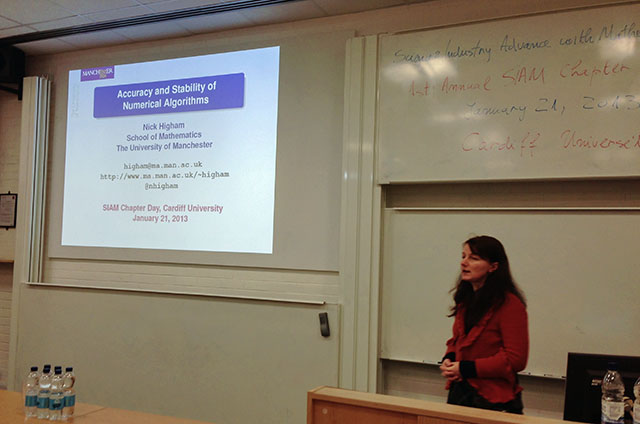
One of SIAM’s newest chapters, its 104th, based at Cardiff University, held its inaugural meeting, the SIAM Chapter Day, on January 21st, 2013.

file://d:/dropbox/org/images/130121-1100-26-1342.jpg
Angela Mihai

Student Chapters of SIAM (The Society for Industrial and Applied Mathematics) are groups based at universities and colleges with the aim of promoting applied mathematics and computational science to young mathematicians. Chapters organize a wide range of activities, including conferences, guest lectures, visits to industry, and social events. They have been an area of growing activity for SIAM in recent years and there are now 108 student chapters worldwide, including 23 outside the United States.

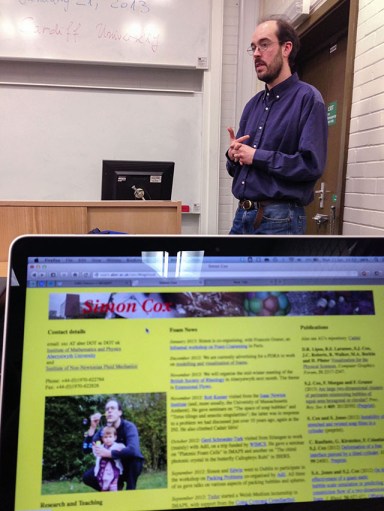
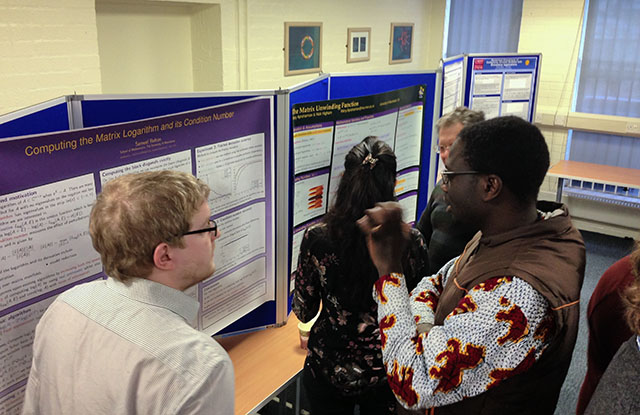
I attended the Cardiff meeting and was one of the speakers, along with Simon Cox (Aberystwyth), Alain Goriely (Oxford) and Matthew Gilbert (Sheffield). The lecture theatre was close to full, with an audience of 70 or so. A significant portion of the audience, and the poster presenters, was from the School of Engineering, reflecting the strong links that exist between mathematics and engineering at Cardiff.

file://d:/dropbox/org/images/130121-1359-33-1378.jpg
Poster session

Angela Mihai is the Chapter’s faculty representative, and also the driving force behind the Chapter being formed. In her opening remarks she mentioned that although this is the Chapter’s launch event, Chapter members have already participated in several events organized by other UK Chapters and the UK & Republic of Ireland SIAM Section. All the signs are that this, the first SIAM Chapter in Wales, will be a great success.

Why and How to Set up a SIAM Student Chapter

SIAM provides funding to support activities, awarding over $36,000 to 74 Student Chapters in the 2012-13 academic year, and it offers support for a Chapter representative to attend the SIAM Annual Meeting and meet with the SIAM leadership. Chapters often collaborate in organizing events, such as the SIAM National Student Chapter Conference held in Manchester in 2012, and these provide an excellent opportunity for networking with like-minded students off campus.

If there is not a SIAM chapter at your institution, it is worth considering setting one up. The process is simple, requiring a letter of intent and petition signed by at least 12 regular or student members of SIAM. If you have trouble getting the signatures I will be happy to help (as will other SIAM officers).

For information on how to set up a Student Chapter see the Student Chapter page on the SIAM website. If you have any questions, contact SIAM’s Membership Manager, Susan Whitehouse, at the address on the web page just mentioned.

See the SIAM Student Blog for ideas on organizing chapter events.

file://d:/dropbox/org/images/130121-1453-01-1390.jpg
Simon Cox

SIAM Books on Google Play

In 2011 SIAM launched an institutional e-book program, which makes SIAM books available by chapter in PDF form for readers at subscribing institutions. As of late 2012, SIAM books are now available for individual e-book purchase from Google Play, for use on tablets, smartphones, e-readers, or computers (but not Kindles). Unlike in the institutional program, these e-books are subject to full digital rights management (DRM), which means users cannot copy them or print from them and only the Google account holder has access to the book.

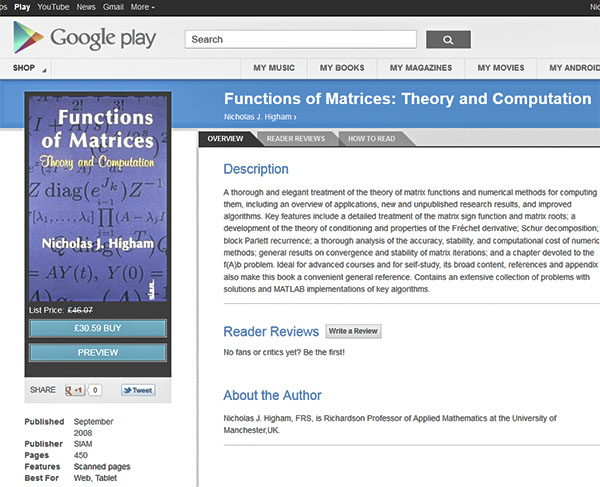
I’ve used the Preview facility to look at a few books on Google Play. My own SIAM books, such as Functions of Matrices (2008), are shown as “scanned pages” and appear to have been scanned from the hard copy; zooming in is supported.

file://d:/dropbox/org/images/google_play_FM.jpg

By comparison, the Princeton Companion to Mathematics can be viewed as “scanned pages” or “flowing text” (ePub format). In the latter, which reformats as you zoom in and seems to be the default, the mathematics renders poorly; this is a shame given the impeccable LaTeX typesetting of the original book.

Is there a good solution yet for how to render mathematics in e-books?

Trefethen’s Approximation Theory and Approximation Practice

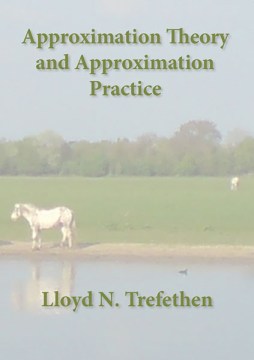
This new 305-page SIAM book by Nick Trefethen presents a modern approach to approximation by polynomials and rational functions. Much of the theory here underlies the Chebfun software package and almost every page of the book contains examples computed using Chebfun.

file://d:/dropbox/org/images/tref12_cover.jpg

The book is certainly a must-read for anyone interested in numerical computation. But the most unusual feature of the book is not immediately obvious: it was entirely produced from 29 MATLAB M-files, one for each chapter. Each M-file contains the book’s text in comment lines intertwined with the MATLAB code that generates the examples and the figures. The book was created by using the MATLAB command publish to generate LaTeX output, which was then run through LaTeX (with a few tweaks for the actual printed book). Nick has made the M-files available at the book’s web page and you can generate the book by running them all through publish.

When I ran publish on one of the M-files it gave a strange error beginning

No method 'createTextNode' with matching signature found for class
'org.apache.xerces.dom.DocumentImpl'.

and I got the same error whatever M-file I tried to publish. This seems to be caused by a clash with some nonstandard M-file on my path, because if I reset the MATLAB path with the matlabrc command (and then add back chebfun to the path) everything works fine.