Talk on Accuracy and Stability at Cardiff

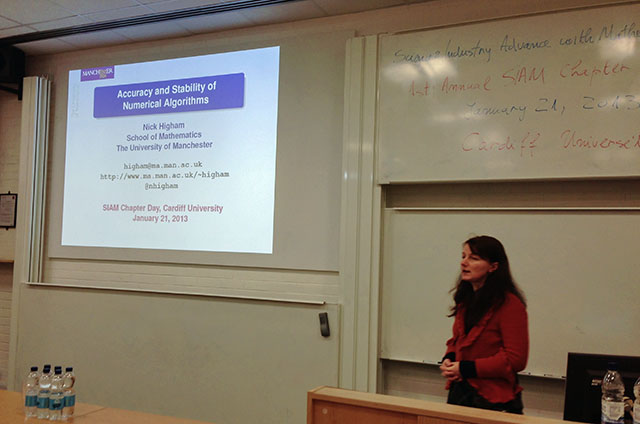
My previous post was about the launch meeting of SIAM Student Chapter at Cardiff, at which I gave the opening talk. My talk was titled Accuracy and Stability of Numerical Algorithms and covered rounding of (floating point) numbers, the interplay between precision and accuracy, higher precision computations, and the effect of tiny relative errors on performance profiles.

Here I describe four examples that I gave where rounding, or the choice of rounding mode, can have interesting or surprising (to some) effects.

  • In 2006 Justin Gatlin was credited with a new world record of 9.76 seconds for the 100m. Almost a week after the race, the time was changed to 9.77 seconds, meaning that he had merely equalled the existing record held by Asafa Powell. The reason for the change was that his recorded time of 9.766 has incorrectly been rounded down to the nearest hundredth of a second instead of up as the IAAF rules require.
  • In 2008 the Mail on Sunday got agitated by the possibility that whether or not the UK inflation target of 3% would be exceeded (and it was exactly 3% at the time) could depend on a change of one thousandth of a percent. They realized that since the inflation rate is published to one decimal place, a rate of 3.049 would round down to 3.0% but 3.050 would round up to 3.1% (since ties are rounded up in UK government calculations) and mean the target had been missed.
  • In 1983 the Vancouver stock exchange found that its index had halved over the year since it had been founded. It turned out that the index had been rounded down after every calculation. When the index was recomputed (presumably with round to nearest, though my reference doesn’t say) it doubled.
  • My telephone and cable provider, Virgin Media, wrote to me in 2007 with news about pricing. They had decreased the cost of my cable and line rental package. They had also changed the way calls charges are calculated by “rounding up to the next minute” instead of “charging to the nearest second” as before. They gave the example that “a call that lasts 4 minutes 50 seconds will be rounded up to 5 minutes”. What they didn’t mention is that a call that lasts 4 minutes 1 second will also be rounded up to 5 minutes!

The talk can be downloaded from my website: Accuracy and Stability of Numerical Algorithms.
First Meeting of Cardiff SIAM Student Chapter

One of SIAM’s newest chapters, its 104th, based at Cardiff University, held its inaugural meeting, the SIAM Chapter Day, on January 21st, 2013.

file://d:/dropbox/org/images/130121-1100-26-1342.jpg
Angela Mihai

Student Chapters of SIAM (The Society for Industrial and Applied Mathematics) are groups based at universities and colleges with the aim of promoting applied mathematics and computational science to young mathematicians. Chapters organize a wide range of activities, including conferences, guest lectures, visits to industry, and social events. They have been an area of growing activity for SIAM in recent years and there are now 108 student chapters worldwide, including 23 outside the United States.

I attended the Cardiff meeting and was one of the speakers, along with Simon Cox (Aberystwyth), Alain Goriely (Oxford) and Matthew Gilbert (Sheffield). The lecture theatre was close to full, with an audience of 70 or so. A significant portion of the audience, and the poster presenters, was from the School of Engineering, reflecting the strong links that exist between mathematics and engineering at Cardiff.

file://d:/dropbox/org/images/130121-1359-33-1378.jpg
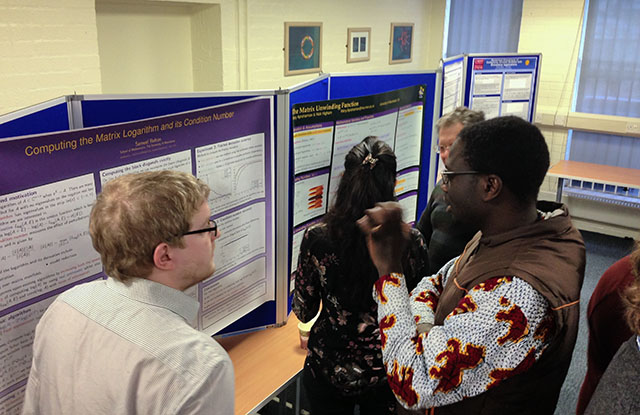
Poster session

Angela Mihai is the Chapter’s faculty representative, and also the driving force behind the Chapter being formed. In her opening remarks she mentioned that although this is the Chapter’s launch event, Chapter members have already participated in several events organized by other UK Chapters and the UK & Republic of Ireland SIAM Section. All the signs are that this, the first SIAM Chapter in Wales, will be a great success.

Why and How to Set up a SIAM Student Chapter

SIAM provides funding to support activities, awarding over $36,000 to 74 Student Chapters in the 2012-13 academic year, and it offers support for a Chapter representative to attend the SIAM Annual Meeting and meet with the SIAM leadership. Chapters often collaborate in organizing events, such as the SIAM National Student Chapter Conference held in Manchester in 2012, and these provide an excellent opportunity for networking with like-minded students off campus.

If there is not a SIAM chapter at your institution, it is worth considering setting one up. The process is simple, requiring a letter of intent and petition signed by at least 12 regular or student members of SIAM. If you have trouble getting the signatures I will be happy to help (as will other SIAM officers).

For information on how to set up a Student Chapter see the Student Chapter page on the SIAM website. If you have any questions, contact SIAM’s Membership Manager, Susan Whitehouse, at the address on the web page just mentioned.

See the SIAM Student Blog for ideas on organizing chapter events.

file://d:/dropbox/org/images/130121-1453-01-1390.jpg
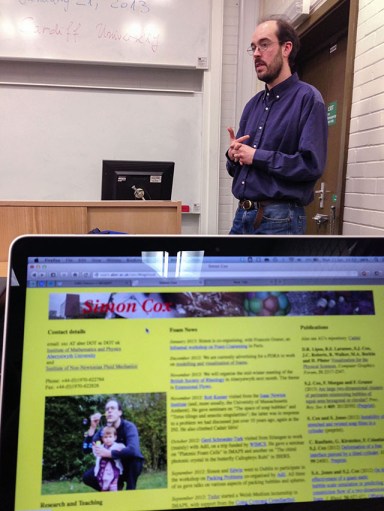
Simon Cox