Singular Values of Rank-1 Perturbations of an Orthogonal Matrix

What effect does a rank-1 perturbation of norm 1 to an n\times n orthogonal matrix have on the extremal singular values of the matrix? Here, and throughout this post, the norm is the 2-norm. The largest singular value of the perturbed matrix is bounded by 2, as can be seen by taking norms, so let us concentrate on the smallest singular value.

Consider first a perturbation of the identity matrix: B = I + xy^T, for unit norm x and y. The matrix B has eigenvalues 1 (repeated n-1 times) and 1 + y^Tx. The matrix is singular—and hence has a zero singular value—precisely when y^Tx = -1, which is the smallest value that the inner product y^Tx can take.

Another example is B = A + yy^T, where A = I - 2yy^T and y has unit norm, so that A is a Householder matrix. Here, B = I - yy^T is singular with null vector y, so it has a zero singular value,

Let’s take a random orthogonal matrix and perturb it with a random rank-1 matrix of unit norm. We use the following MATLAB code.

n = 100; rng(1)
A = gallery('qmult',n); % Random Haar distrib. orthogonal matrix.
x = randn(n,1); y = randn(n,1);
x = x/norm(x); y = y/norm(y);
B = A + x*y';
svd_B = svd(B);
max_svd_B = max(svd_B), min_svd_B = min(svd_B)

The output is

max_svd_B =
1.6065e+00
min_svd_B =
6.0649e-01

We started with a matrix having singular values all equal to 1 and now have a matrix with largest singular value a little larger than 1 and smallest singular value a little smaller than 1. If we keep running this code the extremal singular values of B do not change much; for example, the next run gives

max_svd_B =
1.5921e+00
min_svd_B =
5.9213e-01

A rank-1 perturbation of unit norm could make A singular, as we saw above, but our random perturbations are producing a well conditioned matrix.

What is the explanation? First, note that a rank-1 perturbation to an orthogonal matrix A can only change two of the singular values, because the singular values are the square roots of the eigenvalues of A^T A, which is the identity plus a rank-2 matrix. So n-2 singular values remain at 1.

A result of Benaych-Georges and Nadakuditi (2012) says that for large n the largest and smallest singular values of B tend to (1+\sqrt{5})/2 = 1.618\dots and (-1+\sqrt{5})/2 = 0.618\dots respectively! As our example shows, n does not have to be large for these limits to be approximations correct to roughly the first digit.

The result in question requires the original orthogonal matrix to be from the Haar distribution, and such matrices can be generated by A = gallery('qmult',n) or by the construction

[Q,R] = qr(randn(n));
Q = Q*diag(sign(diag(R)));

(See What Is a Random Orthogonal Matrix?.) The result also requires u and v to be unit-norm random vectors with independent entries from the same distribution.

However, as the next example shows, the perturbed singular values can be close to the values that the Benaych-Georges and Nadakuditi result predicts even when the conditions of the result are violated:

n = 100; rng(1)
A = gallery('orthog',n);   % Random orthogonal matrix (not Haar).
x = rand(n,1); y = (1:n)'; % Non-random y.
x = x/norm(x); y = y/norm(y);
B = A + x*y';
svd_B = svd(B);
max_svd_B = max(svd_B), min_svd_B = min(svd_B)
max_svd_B =
1.6069e+00
min_svd_B =
6.0687e-01

The question of the conditioning of a rank-1 perturbation of an orthogonal matrix arises in the recent EPrint Random Matrices Generating Large Growth in LU Factorization with Pivoting.

Which Fountain Pen Ink for Writing Mathematics?

If, like me, you sometimes prefer to write mathematics on paper before typing into LaTeX, you have the choice of pencil or pen as your writing tool. I’ve written before about writing in pencil. My current tools of choice are fountain pens.

A fountain pen, the ink it contains and the paper used are three independent variables that combine in a complicated way to affect the experience of writing and the results produced. Here, I focus solely on inks and ask what ink one should choose depending on different mathematics-focused requirements.

I give links to reviews on the excellent Mountain of Ink and Pen Addict websites and other pen/ink websites. Unless otherwise stated, I have tried the inks myself.

191224_inks-1.jpg

Fast Drying Time

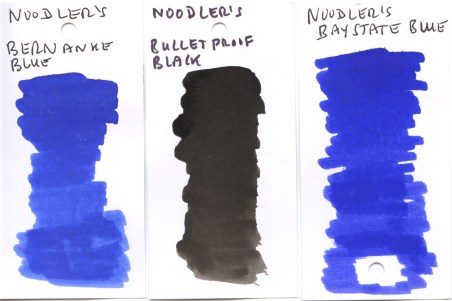
When we write down mathematical working, perhaps in the course of doing research, we are likely to need to go back and make changes to what we have just written. A fast drying ink helps avoid smudges, and it also means we can start writing on the reverse side of a page without pausing to let the ink dry or using blotting paper. Left-handed writers may always need such an ink, depending on their particular style of writing. My favourite fast-drying ink is Noodler’s Bernanke Blue, which is named after Ben Bernanke, former chairman of the Federal Reserve. Downsides are feathering (where the ink spreads out to create rough edges) and bleeding (where ink soaks through on the other side of the page) on lesser grades of paper.

Water Resistance

As mathematicians are major consumers of coffee, what we write risks being spilled on. (Indeed this is so normal an occurrence that Hanno Rein has written a LaTeX package to simulate a coffee stain.) An ink should be reasonably water resistant if spills are not to blur what we have written. Many popular inks have poor water resistance. One of the most water resistant is Noodler’s Bulletproof Black, which also “resists all the known tools of a forger, UV light, UV light wands, bleaches, alcohols, solvent…”. It’s great for writing cheques, as well as mathematics. (But it may not be the blackest black ink, if that matters to you.) Another water resistant ink is Noodler’s Baystate Blue (see below).

Interesting Names

Sometimes, writing with an interestingly named pen, paper or ink can provide inspiration. While many Coloverse inks have a space or physics theme, I am not aware of any mathematically named inks.

Vibrant Inks

Vibrant inks are great for annotating a printout or writing on paper with heavy lines, squares or dots. An outstanding ink in this respect is Noodler’s Baystate Blue, an incredibly intense, bright blue that jumps off the page. The downsides are bleeding and staining. An ink to be used with caution! I also like the much better behaved Pilot Iroshizuku Fuyu-gaki (orange) and Pilot Iroshizuku Kon-peki (blue).

191224_inks-2.jpg

For Marking (Grading)

For marking scripts one obviously needs to use a different colour than the student has used. Traditionally, this is red. A couple of my favourites for marking are Waterman Audacious Red and Cult Pens Deep Dark Orange.

Shading, Sheen and Shimmer

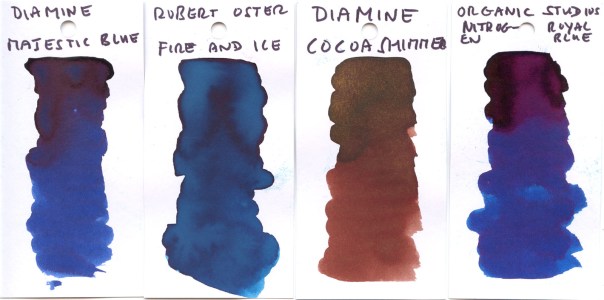
Many inks have one or more of the properties of shading, sheen and shimmer. Shading is where an ink appears darker or lighter in different parts of a stroke; sheen is where an ink shines with a different colour; and shimmer is where particles have been added to the ink that cause it to shimmer or glisten when it catches the light. The strength of all these effects is strongly dependent on the pen, the nib size and the paper, and for shimmer the pen needs to be moved around to distribute the particles before writing. (Sheen and shimmer do not show up well on the scans shown in this post.) Among my favourites are Diamine Majestic Blue (blue with purple sheen), Robert Oster Fire and Ice (teal with shading and pink sheen) and Diamine Cocoa Shimmer (brown with gold shimmer). For “monster sheen”, try Organic Studios Nitrogen Royal Blue, but note that it is hard to clean out of a pen.

191224_inks-3.jpg

Nonstandard Surfaces

Much mathematics is written on bar mats, napkins, paper towels, backs of envelopes, newspapers, tablecloths, and anything that is to hand, especially when mathematicians work together away from their desks. These surfaces are not fountain-pen friendly. One promising ink for such situations is Noodler’s X-Feather, which was created to combat feathering on cheap paper. (I have not tried this ink.)

All Rounders

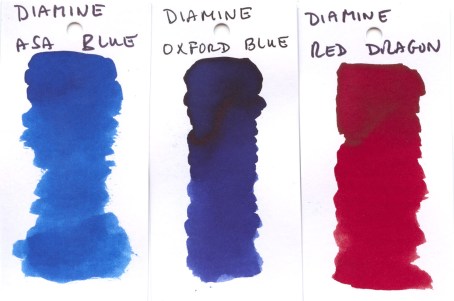
Finally, three good all-round inks that I’ve used a lot when working on my books and papers are Diamine Asa Blue, Diamine Oxford Blue, and Diamine Red Dragon.

191224_inks-4.jpg

What Is IEEE Standard Arithmetic?

The IEEE Standard 754, published in 1985 and revised in 2008 and 2019, is a standard for binary and decimal floating-point arithmetic. The standard for decimal arithmetic (IEEE Standard 854) was separate when it was first published in 1987, but it was included with the binary standard from 2008. We focus here on the binary part of the standard.

The standard specifies floating-point number formats, the results of the basic floating-point operations and comparisons, rounding modes, floating-point exceptions and their handling, and conversion between different arithmetic formats.

A binary floating-point number is represented as

y = \pm m \times 2^{e-t},

where t is the precision and e\in [e_{\min},e_{\max}] is the exponent. The significand m is an integer satisfying m \le 2^t-1. Numbers with m \ge 2^{t-1} are called normalized. Subnormal numbers, for which 0 < m <2^{t-1} and e = e_{\min}, are supported.

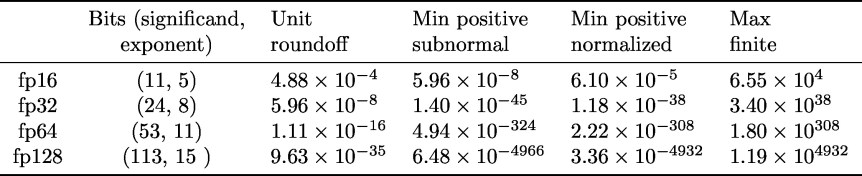
Four formats are defined, whose key parameters are summarized in the following table. The second column shows the number of bits allocated to store the significand and the exponent. I use the prefix “fp” instead of the prefix “binary” used in the standard. The unit roundoff is u = 2^{-t}.

ieee_params_table.jpg Fp32 (single precision) and fp64 (double precision) were in the 1985 standard; fp16 (half precision) and fp128 (quadruple precision) were introduced in 2008. Fp16 is defined only as a storage format, though it is widely used for computation.
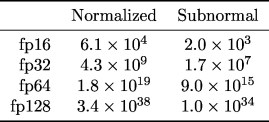
The size of these different number systems varies greatly. The next table shows the number of normalized and subnormal numbers in each system.

flpt_count.jpg

We see that while one can easily carry out a computation on every fp16 number (to check that the square root function is correctly computed, for example), it is impractical to do so for every double precision number.

A key feature of the standard is that it is a closed system, thanks to the inclusion of NaN (Not a Number) and \infty (usually written as inf in programing languages) as floating-point numbers: every arithmetic operation produces a number in the system. A NaN is generated by operations such as


0/0, \quad 0 \times \infty, \quad \infty/\infty, \quad (+\infty) + (-\infty), \quad \sqrt{-1}.

Arithmetic operations involving a NaN return a NaN as the answer. The number \infty obeys the usual mathematical conventions regarding infinity, such as

\infty+\infty = \infty, \quad (-1)\times\infty = -\infty, \quad   ({\textrm{finite}})/\infty = 0.

This means, for example, that 1 + 1/x evaluates as 1 when x = \infty.

The standard specifies that all arithmetic operations (including square root) are to be performed as if they were first calculated to infinite precision and then rounded to the target format. A number is rounded to the next larger or next smaller floating-point number according to one of four rounding modes:

  • round to the nearest floating-point number, with rounding to even (rounding to the number with a zero least significant bit) in the case of a tie;
  • round towards plus infinity and round towards minus infinity (used in interval arithmetic); and
  • round towards zero (truncation, or chopping).

For round to nearest it follows that

\mathrm{f\kern.2ptl}(x\mathbin{\mathrm{op}} y)     = (x \mathbin{\mathrm{op}} y)(1+\delta),     \quad |\delta|\le u, \quad \mathbin{\mathrm{op}}\in\{+,-,*,/,\sqrt{}\},

where \mathrm{f\kern.2ptl} denotes the computed result. The standard also includes a fused multiply-add operation (FMA), x*y + z. The definition requires it to be computed with just one rounding error, so that \mathrm{f\kern.2ptl}(x*y+z) is the rounded version of x*y+z, and hence satisfies

\mathrm{f\kern.2ptl}(x*y + z) = (x*y + z)(1+\delta), \quad |\delta|\le u.

FMAs are supported in some hardware and are usually executed at the same speed as a single addition or multiplication.

The standard recommends the provision of correctly rounded exponentiation (x^y) and transcendental functions (\exp, \log, \sin, \mathrm{acos}, etc.) and defines domains and special values for them, but these functions are not required.

A new feature of the 2019 standard is augmented arithmetic operations, which compute \mathrm{fl}(x \mathbin{\mathrm{op}}y) along with the error x\mathbin{\mathrm{op}}y - \mathrm{fl}(x \mathbin{\mathrm{op}}y), for \mathbin{\mathrm{op}} = +,-,*. These operations are useful for implementing compensated summation and other special high accuracy algorithms.

William (“Velvel”) Kahan of the University of California at Berkeley received the 1989 ACM Turing Award for his contributions to computer architecture and numerical analysis, and in particular for his work on IEEE floating-point arithmetic standards 754 and 854.

References

This is a minimal set of references, which contain further useful references within.

What Is Floating-Point Arithmetic?

A floating-point number system F is a finite subset of the real line comprising numbers of the form

y = \pm m \times \beta^{e-t},

where \beta is the base, t is the precision, and e\in [e_{\min},e_{\max}] is the exponent. The system is completely defined by the four integers \beta, t, e_{\min}, and e_{\max}. The significand m satisfies 0 \le m \le \beta^t-1. Normalized numbers are those for which m \ge \beta^{t-1}, and they have a unique representation. Subnormal numbers are those with 0 < m < \beta^{t-1} and e = e_{\min}.

An alternative representation of y\in F is

y = \pm \beta^e               \left( \displaystyle\frac{d_1}{\beta} +                      \frac{d_2}{\beta^2} + \cdots +                      \frac{d_t}{\beta^t} \right)         = \pm \beta^e \times .d_1 d_2 \dots d_t,

where each digit d_i satisfies 0 \le d_i \le \beta-1 and d_1 \ne 0 for normalized numbers.

The floating-point numbers are not equally spaced, but they have roughly constant relative spacing (varying by up to a factor \beta).

Here are the normalized nonnegative numbers in a toy system with \beta = 2, t = 3, and e \in [-1, 3].

flpt_numbers_fig.jpg

Three key properties that hold in general for binary arithmetic are visible in this example.

  • The spacing of the numbers increases by a factor 2 at every power of 2.
  • The spacing of the numbers between 1/2 and 1 is u = 2^{-t}, which is called the unit roundoff. The spacing of the numbers between 1 and 2 is \epsilon = 2^{1-t}, which is called the machine epsilon. Note that \epsilon = 2u.
  • There is a gap between 0 and the smallest normalized number, which is 2^{e_{\min}-1}. The subnormal numbers fill this gap with numbers having the same spacing as those between 2^{e_{\min}-1} and 2^{e_{\min}}, namely 2^{e_{\min}-t}. The next diagram shows the complete set of nonnegative normalized and subnormal numbers in the toy system.

flpt_numbers_all_fig.jpg

In MATLAB, eps is the machine epsilon, eps(x) is the distance from x to the next larger (in magnitude) floating-point number, realmax is the largest finite number, and realmin is the smallest normalized positive number.

A real number x is mapped into F by rounding, and the result is denoted by \mathrm{f\kern.2ptl}(x). If x exceeds the largest number in F then we say that \mathrm{f\kern.2ptl}(x) overflows, and in IEEE arithmetic it is represented by Inf. If x\in F then \mathrm{f\kern.2ptl}(x) = x; otherwise, x lies between two floating-point numbers and we need a rule for deciding which one to round x to. The usual rule, known as round to nearest, is to round to whichever number is nearer. If x is midway between two floating-point numbers then we need a tie-breaking rule, which is usually to round to the number with an even last digit. If x\ne0 and \mathrm{f\kern.2ptl}(x) = 0 then \mathrm{f\kern.2ptl}(x) is said to underflow.

For round to nearest it can be shown that

\mathrm{f\kern.2ptl}(x)  = x(1+\delta), \quad |\delta|\le u.

This result shows that rounding introduces a relative error no larger than u.

Elementary floating-point operations, +, -, *, /, and \sqrt{} are usually defined to return the correctly rounded exact result, so they satisfy

\mathrm{f\kern.2ptl}(x\mathbin{\mathrm{op}} y)     = (x \mathbin{\mathrm{op}} y)(1+\delta),     \quad |\delta|\le u, \quad \mathbin{\mathrm{op}}\in\{+,-,*,/,\sqrt{}\}.

Most floating-point arithmetics adhere to the IEEE standard, which defines several floating-point formats and four different rounding modes.

Another form of finite precision arithmetic is fixed-point arithmetic, in which numbers have the same form as F but with a fixed exponent e, so all the numbers are equally spaced. In most scientific computations scale factors must be introduced in order to be able to represent the range of numbers occurring. Fixed-point arithmetic is mainly used on special purpose devices such as FPGAs and in embedded systems.

References

This is a minimal set of references, which contain further useful references within.

Related Blog Posts

This article is part of the “What Is” series, available from https://nhigham.com/category/what-is and in PDF form from the GitHub repository https://github.com/higham/what-is.

What Is Rounding?

Rounding is the transformation of a number expressed in a particular base to a number with fewer digits. For example, in base 10 we might round the number x = 7.146 to 7.15, which can be described as rounding to three significant digits or two decimal places. Rounding does not change a number if it already has the requisite number of digits.

The three main uses of rounding are

  • to simplify a number in base 10 for human consumption,
  • to represent a constant such as 1/3, \pi, or \sqrt{7} in floating-point arithmetic,
  • to convert the result of an elementary operation (an addition, multiplication, or division) on floating-point numbers back into a floating-point number.

The floating-point numbers may be those used on a computer (base 2) or a pocket calculator (base 10).

Rounding can be done in several ways.

Round to Nearest

The most common form of rounding is to round to the nearest number with the specified number of significant digits or decimal places. In the example above, the two nearest numbers to x with three significant digits are 7.14 and 7.15, at distances 0.006 and 0.004, respectively, from x. The nearest of these two numbers, 7.15, is chosen.

What happens if the two candidate numbers are equally close? We need a rule for breaking the tie. The most common choices are

  • round to even: choose the number with an even last digit,
  • round to odd: choose the number with an odd last digit.

If we round 1.85 to two significant digits, the result is 1.8 with round to even and 1.9 with round to odd.

There are several reasons for preferring to break ties with round to even.

  • In bases 2 and 10 a subsequent rounding to one less place does not involve a tie. Thus we have the rounding sequence 2.445, 2.44, 2.4, 2 with round to even, but 2.445, 2.45, 2.5, 3 with round to odd.
  • For base 2, round to even results in integers more often, as a consequence of producing a zero least significant bit.
  • In base 10, after round to even a rounded number can be halved without error.

IEEE Standard 745 for floating-point arithmetic supports three tie-breaking methods: round to even (the default), round to the number with larger magnitude, and round towards zero (introduced in the 2019 revision for use with the standard’s new augmented operations).

The tie-breaking rule taught in UK schools, for decimal arithmetic, is to round up on ties. The rounding rule then becomes: round down if the first digit to be dropped is 4 or less and otherwise round up.

Round Towards Plus or Minus Infinity

Another possibility is to round to the next larger number with the specified number of digits, which is known as round towards plus infinity (or round up). Then 1.85 rounds to 1.9 and -2.34 rounds to -2.3. Similarly, with round towards minus infinity (or round down) we round to the next smaller number, so that 1.85 rounds to 1.8 and -2.34 rounds to -2.4.

This form of rounding is used in interval arithmetic, where an interval guaranteed to contain the exact result is computed in floating-point arithmetic.

Round Towards Zero

In this form of rounding we round towards zero, that is, we round x down if x > 0 and round it up if x < 0. This is also known as chopping, or truncation.

Stochastic Rounding

Stochastic rounding was proposed in the 1950s and is attracting renewed interest, especially in machine learning. It rounds up or down randomly. It come in two forms. The first form rounds up or down with equal probability 1/2. To describe the second form, let x be the given number and let x_1  x be the candidates for the result of rounding. We round up to x_2 with probability (x-x_1)/(x_2-x_1) and down to x_1 with probability (x_2-x)/(x_2-x_1); note that these probabilities sum to 1. In floating-point arithmetic, stochastic rounding overcomes the problem that can arise in summing a set of numbers whereby some individual summands are so small that they do not contribute to the computed sum even though they contribute to the exact sum.

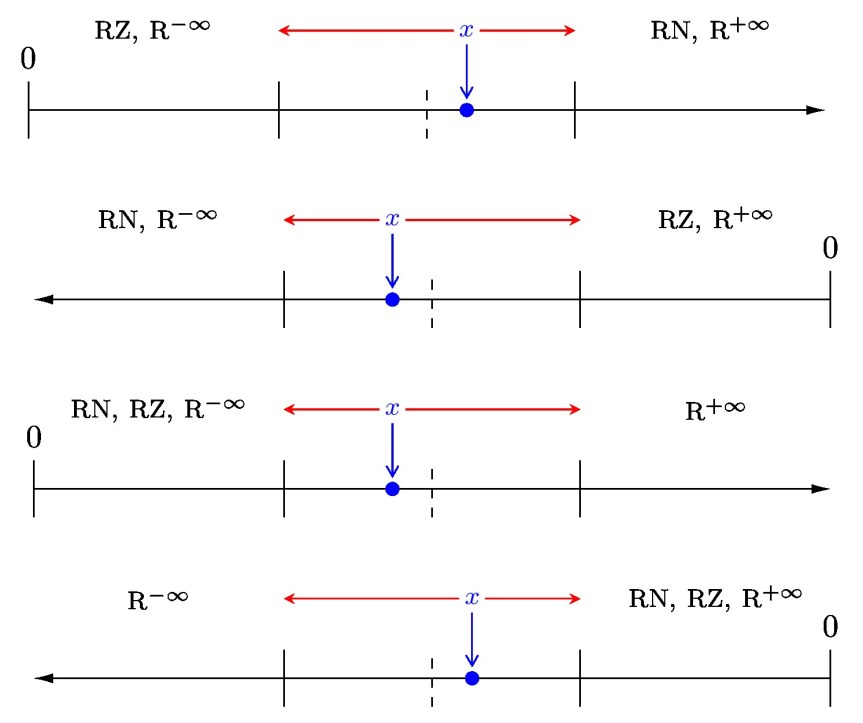
The diagrams below illustrate round to nearest (RN), round towards zero (RZ), round towards plus infinity (\mathrm{R}^{+\infty}), and round towards minus infinity (\mathrm{R}^{-\infty}). They show the number x to be rounded in four different configurations with respect to the origin and the midpoint (drawn with a dotted line) of the interval between the two candidate rounding results (drawn with a solid line). The red arrows point to the two possible results of rounding.

rounding_fig.jpg

Real World Rounding

The European Commission’s rules for converting currencies of Member States into Euros (from the time of the creation of the Euro) specify that “half-way results are rounded up” (rounded to plus infinity). (PDF link)

The International Association of Athletics Federations (IAAF) specifies in Rule 165 of its Competition Rules 2018–2019 that all times of track races up to 10,000m should be recorded to a precision of 0.01 second, with rounding to plus infinity. In 2006, the athlete Justin Gatlin was wrongly credited with breaking the 100m world record when his official time of 9.766 seconds was rounded down to 9.76 seconds. Under the IAAF rules it should have been rounded up to 9.77 seconds, matching the world record set by Asafa Powell the year before. The error was discovered several days after the race.

In meteorology, rounding to nearest with ties broken by rounding to odd is favoured. Hunt suggests that the reason is to avoid falsely indicating that it is freezing. Thus 0.5^\circC and 32.5^\circF round to 1^\circC and 33^\circF instead of 0^\circC and 32^\circF.

Useful Tool

The \LaTeX package siunitx has the ability to round numbers (in base 10) to a specified number of decimal places or significant figures.

References

This is a minimal set of references, which contain further useful references within.

Related Blog Posts

  • What Is Floating-Point Arithmetic? (2020)—forthcoming
  • What Is IEEE Standard Arithmetic? (2020)—forthcoming

This article is part of the “What Is” series, available from https://nhigham.com/category/what-is and in PDF form from the GitHub repository https://github.com/higham/what-is.

What Is a Random Orthogonal Matrix?

Various explicit parametrized formulas are available for constructing orthogonal matrices. To construct a random orthogonal matrix we can take such a formula and assign random values to the parameters. For example, a Householder matrix H = I - 2uu^T/(u^Tu) is orthogonal and symmetric and we can choose the nonzero vector u randomly. Such an example is rather special, though, as it is a rank-1 perturbation of the identity matrix.

What is usually meant by a random orthogonal matrix is a matrix distributed according to the Haar measure over the group of orthogonal matrices. The Haar measure provides a uniform distribution over the orthogonal matrices. Indeed it is invariant under multiplication on the left and the right by orthogonal matrices: if Q is from the Haar distribution then so is UQV for any orthogonal (possibly non-random) U and V. A random Householder matrix is not Haar distributed.

A matrix from the Haar distribution can be generated as the orthogonal factor in the QR factorization of a random matrix with elements from the standard normal distribution (mean 0, variance 1). In MATLAB this is done by the code

[Q,R] = qr(randn(n));
Q = Q*diag(sign(diag(R)));

The statement [Q,R] = qr(randn(n)), which returns the orthogonal factor Q, is not enough on its own to give a Haar distributed matrix, because the QR factorization is not unique. The second line adjusts the signs so that Q is from the unique factorization in which the triangular factor R has nonnegative diagonal elements. This construction requires 2n^3 flops.

A more efficient construction is possible, as suggested by Stewart (1980). Let x_k be an (n-k+1)-vector of elements from the standard normal distribution and let H_k be the Householder matrix that reduces x_k to r_{kk}e_1, where e_1 is the first unit vector. Then Q = DH'_1H'_2\dots H'_{n-1} is Haar distributed, where H'_k = \mathrm{diag}(I_{k-1}, H_k), D = \mathrm{diag}(\mathrm{sign}(r_{kk})), and r_{nn} = x_n. This construction expresses Q as the product of n-1 Householder matrices of growing effective dimension, and the product can be formed from right to left in 4n^3/3 flops. The MATLAB statement Q = gallery('qmult',n) carries out this construction.

A similar construction can be made using Givens rotations (Anderson et al., 1987).

Orthogonal matrices from the Haar distribution can also be formed as Q = A (A^TA)^{-1/2}, where the elements of A are from the standard normal distribution. This Q is the orthogonal factor in the polar decomposition A = QH (where H is symmetric positive semidefinite).

Random orthogonal matrices arise in a variety of applications, including Monte Carlo simulation, random matrix theory, machine learning, and the construction of test matrices with known eigenvalues or singular values.

All these ideas extend to random unitary (complex) matrices. In MATLAB, Haar distributed unitary matrices can be constructed by the code

[Q,R] = qr(complex(randn(n),randn(n)));
Q = Q*diag(sign(diag(R)));

This code exploits the fact that the R factor computed by MATLAB has real diagonal entries. If the diagonal of R were complex then this code would need to be modified to use the complex sign function given by \mathrm{sign}(z) = z/|z|.

References

This is a minimal set of references, which contain further useful references within.

Related Blog Posts

This article is part of the “What Is” series, available from https://nhigham.com/category/what-is and in PDF form from the GitHub repository https://github.com/higham/what-is.

What Is a Correlation Matrix?

In linear algebra terms, a correlation matrix is a symmetric positive semidefinite matrix with unit diagonal. In other words, it is a symmetric matrix with ones on the diagonal whose eigenvalues are all nonnegative.

The term comes from statistics. If x_1, x_2, \dots, x_n are column vectors with m elements, each vector containing samples of a random variable, then the corresponding n\times n covariance matrix V has (i,j) element

v_{ij} = \mathrm{cov}(x_i,x_j) = \displaystyle\frac{1}{n-1}            (x_i - \overline{x}_i)^T (x_j - \overline{x}_j),

where \overline{x}_i is the mean of the elements in x_i. If v has nonzero diagonal elements then we can scale the diagonal to 1 to obtain the corresponding correlation matrix

C = D^{-1/2} V D^{-1/2},

where D = \mathrm{diag}(v_{ii}). The (i,j) element c_{ij} = v_{ii}^{-1/2} v_{ij} v_{jj}^{-1/2} is the correlation between the variables x_i and x_j.

Here are a few facts.

  • The elements of a correlation matrix lie on the interval [-1, 1].
  • The eigenvalues of a correlation matrix lie on the interval [0,n].
  • The eigenvalues of a correlation matrix sum to n (since the eigenvalues of a matrix sum to its trace).
  • The maximal possible determinant of a correlation matrix is 1.

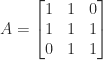
It is usually not easy to tell whether a given matrix is a correlation matrix. For example, the matrix

A = \begin{bmatrix}      1  &  1 &   0\\      1  &  1 &   1\\      0  &  1 &   1      \end{bmatrix}

is not a correlation matrix: it has eigenvalues -0.4142, 1.0000, 2.4142. The only value of a_{13} and a_{31} that makes A a correlation matrix is 1.

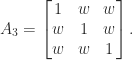
A particularly simple class of correlation matrices is the one-parameter class A_n with every off-diagonal element equal to w, illustrated for n = 3 by

A_3 = \begin{bmatrix}      1  &  w &   w\\      w  &  1 &   w\\      w  &  w &   1      \end{bmatrix}.

The matrix A_n is a correlation matrix for -1/(n-1) \le w \le 1.

In some applications it is required to generate random correlation matrices, for example in Monte-Carlo simulations in finance. A method for generating random correlation matrices with a specified eigenvalue distribution was proposed by Bendel and Mickey (1978); Davies and Higham (2000) give improvements to the method. This method is implemented in the MATLAB function gallery('randcorr').

Obtaining or estimating correlations can be difficult in practice. In finance, market data is often missing or stale; different assets may be sampled at different time points (e.g., some daily and others weekly); and the matrices may be generated from different parametrized models that are not consistent. Similar problems arise in many other applications. As a result, correlation matrices obtained in practice may not be positive semidefinite, which can lead to undesirable consequences such as an investment portfolio with negative risk.

In risk management and insurance, matrix entries may be estimated, prescribed by regulations or assigned by expert judgement, but some entries may be unknown.

Two problems therefore commonly arise in connection with correlation matrices.

Nearest Correlation Matrix

Here, we have an approximate correlation matrix A that has some negative eigenvalues and we wish to replace it by the nearest correlation matrix. The natural choice of norm is the Frobenius norm, \|A\|_F = \bigl(\sum_{i,j} a_{ij}^2\bigr)^{1/2}, so we solve the problem

\min \{ \, \|A-C\|_F: C~\textrm{is a correlation matrix} \,\}.

We may also have a requirement that certain elements of C remain fixed. And we may want to weight some elements more than others, by using a weighted Frobenius norm. These are convex optimization problems and have a unique solution that can be computed using the alternating projections method (Higham, 2002) or a Newton algorithm (Qi and Sun, 2006; Borsdorf and Higham, 2010).

Another variation requires C to have factor structure, which means that the off-diagonal agrees with that of a rank-k matrix for some given k (Borsdorf, Higham, and Raydan, 2010). Yet another variation imposes a constraint that C has a certain rank or a rank no larger than a certain value. These problems are non-convex, because of the objective function and the rank constraint, respectively.

Another approach that can be used for restoring definiteness, although it does not in general produce the nearest correlation matrix, is shrinking, which constructs a convex linear combination A = \alpha C + (1-\alpha)M, where M is a target correlation matrix (Higham, Strabić, and Šego, 2016). Shrinking can readily incorporate fixed blocks and weighting.

Correlation Matrix Completion

Here, we have a partially specified matrix and we wish to complete it, that is, fill in the missing elements in order to obtain a correlation matrix. It is known that a completion is possible for any set of specified entries if the associate graph is chordal (Grone et al., 1994). In general, if there is one completion there are many, but there is a unique one of maximal determinant, which is elegantly characterized by the property that the inverse contains zeros in the positions of the unspecified entries.

References

This is a minimal set of references, and they cite further useful references.

Related Blog Posts

What Is a Hadamard Matrix?

A Hadamard matrix is an n\times n matrix with elements \pm 1 and mutually orthogonal columns. For example,

\left[\begin{array}{rrrr}       1 & 1 & 1 & 1\\       1 & -1 & 1 & -1\\       1 & 1 & -1 & -1\\       1 & -1 & -1 & 1 \end{array}\right]

is a Hadamard matrix.

A necessary condition for an n\times n Hadamard matrix to exist with n > 2 is that n is divisible by 4, but it is not known if a Hadamard matrix exists for every such n.

A Hadamard matrix of order 428 was found for the first time in 2005. The smallest multiple of 4 for which a Hadamard matrix has not been found is 668.

A Hadamard matrix satisfies H^T H = nI, so H^{-1} = n^{-1}H^T. It also follows that \det(H) = \pm n^{n/2}. Hadamard’s inequality states that for an n\times n real matrix A, |\det(A)| \le \prod_{k=1}^n \|a_k\|_2, where a_k is the kth column of A. A Hadamard matrix achieves equality in this inequality (as does any matrix with orthogonal columns).

Hadamard matrices can be generated with a recursive (Kronecker product) construction: if H is a Hadamard matrix then so is

\left[\begin{array}{rr}          H & H\\          H & -H   \end{array}\right].

So starting with a Hadamard matrix of size m, one can build up matrices of size 2^km for k = 1,2,\dots. The MATLAB hadamard function uses this technique. It includes the following Hadamard matrix of order 12, for which we simply display the signs of the elements:

\left[\begin{array}{rrrrrrrrrrrr} {}+ & + & + & + & + & 1 & + & + & + & + & + & +\\ {}+ & - & + & - & + & + & + & - & - & - & + & -\\ {}+ & - & - & + & - & + & + & + & - & - & - & +\\ {}+ & + & - & - & + & - & + & + & + & - & - & -\\ {}+ & - & + & - & - & + & - & + & + & + & - & -\\ {}+ & - & - & + & - & - & + & - & + & + & + & -\\ {}+ & - & - & - & + & - & - & + & - & + & + & +\\ {}+ & + & - & - & - & + & - & - & + & - & + & +\\ {}+ & + & + & - & - & - & + & - & - & + & - & +\\ {}+ & + & + & + & - & - & - & + & - & - & + & -\\ {}+ & - & + & + & + & - & - & - & + & - & - & +\\ {}+ & + & - & + & + & + & - & - & - & + & - & - \end{array}\right].

Hadamard matrices have applications in optimal design theory, coding theory, and graph theory.

In numerical analysis, Hadamard matrices are of interest because when LU factorization is performed on them they produce a growth factor of at least n, for any form of pivoting. Evidence suggests that the growth factor for complete pivoting is exactly n, but this has not been proved. It has been proved that any n\times n Hadamard matrix has growth factor n for complete pivoting for n = 12 and n = 16.

An interesting property of Hadamard matrices is that the p-norm (the matrix norm subordinate to the vector p-norm) is known explicitly for all p:

\|H\|_p = \max\bigl( n^{1/p}, n^{1-1/p} \bigr), \quad 1\le p\le \infty.

References

This is a minimal set of references, which contain further useful references within.

Related Blog Posts

This article is part of the “What Is” series, available from https://nhigham.com/category/what-is and in PDF form from the GitHub repository https://github.com/higham/what-is.

What Is an Orthogonal Matrix?

A real, square matrix Q is orthogonal if Q^TQ = QQ^T = I (the identity matrix). Equivalently, Q^{-1} = Q^T. The columns of an orthogonal matrix are orthonormal, that is, they have 2-norm (Euclidean length) 1 and are mutually orthogonal. The same is true of the rows.

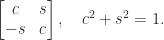
Important examples of orthogonal matrices are rotations and reflectors. A 2\times 2 rotation matrix has the form

\begin{bmatrix}             c & s \\             -s& c \\      \end{bmatrix},       \quad c^2 + s^2 = 1.

For such a matrix, c = \cos \theta and s = \sin \theta for some \theta, and the multiplication y = Qx for a 2\times 1 vector x represents a rotation through an angle \theta radians. An n\times n rotation matrix is formed by embedding the 2\times 2 matrix into the identity matrix of order n.

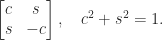
A Householder reflector is a matrix of the form H = I - 2uu^T/(u^Tu), where u is a nonzero n-vector. It is orthogonal and symmetric. When applied to a vector it reflects the vector about the hyperplane orthogonal to v. For n = 2, such a matrix has the form

\begin{bmatrix}     c &  s \\      s& -c \\      \end{bmatrix}, \quad c^2 + s^2 = 1.

Here is the 4\times 4 Householder reflector corresponding to v = [1,1,1,1]^T/2:

\frac{1}{2}         \left[\begin{array}{@{\mskip2mu}rrrr@{\mskip2mu}}                        1 &   -1 &   -1 &   -1\\                       -1 &    1 &   -1 &   -1\\                       -1 &   -1 &    1 &   -1\\                       -1 &   -1 &   -1 &    1\\        \end{array}\right].

This is 1/2 times a Hadamard matrix.

Various explicit formulas are known for orthogonal matrices. For example, the n\times n matrices with (i,j) elements

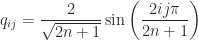
q_{ij} = \displaystyle\frac{2}{\sqrt{2n+1}}        \sin \left(\displaystyle\frac{2ij\pi}{2n+1}\right)

and

q_{ij} =              \sqrt{\displaystyle\frac{2}{n}}\cos              \left(\displaystyle\frac{(i-1/2)(j-1/2)\pi}{n} \right)

are orthogonal. These and other orthogonal matrices, as well as diagonal scalings of orthogonal matrices, are constructed by the MATLAB function gallery('orthog',...).

Here are some properties of orthogonal matrices.

  • All the eigenvalues are on the unit circle, that is, they have modulus 1.
  • All the singular values are 1.
  • The 2-norm condition number is 1, so orthogonal matrices are perfectly conditioned.
  • Multiplication by an orthogonal matrix preserves Euclidean length: \|Qx\|_2 = \|x\|_2 for any vector x.
  • The determinant of an orthogonal matrix is \pm 1. A rotation has determinant 1 while a reflection has determinant -1.

Orthogonal matrices can be generated from skew-symmetric ones. If S is skew-symmetric (S = -S^T) then \exp(S) (the matrix exponential) is orthogonal and the Cayley transform (I-S)(I+S)^{-1} is orthogonal as long as S has no eigenvalue equal to -1.

Unitary matrices are complex square matrices Q for which Q^*Q = QQ^* = I, where Q^* is the conjugate transpose of Q. They have analogous properties to orthogonal matrices.

Related Blog Posts

  • What Is a Hadamard Matrix? (2020)—forthcoming
  • What Is a Random Orthogonal Matrix? (2020)—forthcoming

This article is part of the “What Is” series, available from https://nhigham.com/category/what-is and in PDF form from the GitHub repository https://github.com/higham/what-is.

What Is a Generalized Inverse of a Matrix?

The matrix inverse is defined only for square nonsingular matrices. A generalized inverse is an extension of the concept of inverse that applies to square singular matrices and rectangular matrices. There are many definitions of generalized inverses, all of which reduce to the usual inverse when the matrix is square and nonsingular.

A large class of generalized inverses of an m \times n matrix A can be defined in terms of the Moore–Penrose conditions, in which X is n\times m:

\begin{array}{rcrc}  \mathrm{(1)}   &    AXA = A,  \; & \mathrm{(2)} & XAX=X,\\  \mathrm{(3)} & (AX)^* = AX, \; & \mathrm{(4)} & (XA)^* = XA. \end{array}

Here, the superscript * denotes the conjugate transpose. A 1-inverse is any X satisfying condition (1), a (1,3)-inverse is any X satisfying conditions (1) and (3), and so on for any subset of the four conditions.

Condition (1) implies that if Ax = b then A(Xb) = A (XAx) = AXAx = Ax = b, so Xb solves the equation, meaning that any 1-inverse is an equation-solving inverse. Condition (2) implies that X = 0 if A = 0.

A (1,3) inverse can be shown to provide a least squares solution to an inconsistent linear system. A (1,4) inverse can be shown to provide the minimum 2-norm solution of a consistent linear system (where the 2-norm is defined by \|x\|_2 = (x^*x)^{1/2}).

There is not a unique matrix satisfying any one, two, or three of the Moore–Penrose conditions. But there is a unique matrix satisfying all four of the conditions, and it is called the Moore-Penrose pseudoinverse, denoted by A^+ or A^{\dagger}. For any system of linear equations Ax = b, x = A^+b minimizes \|Ax - b\|_2 and has the minimum 2–norm over all minimizers.

The pseudoinverse can be expressed in terms of the singular value decomposition (SVD). If A = U\Sigma V^* is an SVD, where the m\times m matrix U and n\times n matrix V are orthogonal, and \Sigma = \mathrm{diag}(\sigma_1,\dots , \sigma_n) with \sigma_1 \ge \sigma_2 \ge \cdots \ge \sigma_r > \sigma_{r+1} = \cdots =\sigma_n = 0 (so that \mathrm{rank}(A) = r), then

A^+ = V\mathrm{diag}(\sigma_1^{-1},\dots,\sigma_r^{-1},0,\dots,0)U^*.

In MATLAB, the function pinv computes A^+ using this formula. If \mathrm{rank}(A) = n then the concise formula A^+ = (A^*A)^{-1}A^* holds.

For square matrices, the Drazin inverse is the unique matrix A^D such that

A^D A A^D = A^D, \quad A A ^D = A^D A, \quad        A^{k+1} A^D = A^k,

where k = \mathrm{index}(A). The first condition is the same as the second of the Moore–Penrose conditions, but the second and third have a different flavour. The index of a matrix of A is the smallest nonnegative integer k such that \mathrm{rank}(A^k) = \mathrm{rank}(A^{k+1}); it is characterized as the dimension of the largest Jordan block of A with eigenvalue zero.

If \mathrm{index}(A)=1 then A^D is also known as the group inverse of A and is denoted by A^\#. The Drazin inverse is an equation-solving inverse precisely when \mathrm{index}(A)\le 1, for then AA^DA=A, which is the first of the Moore–Penrose conditions.
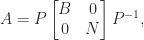
The Drazin inverse can be represented explicitly as follows. If

A = P \begin{bmatrix}                B & 0 \\                0 & N               \end{bmatrix} P^{-1},

where P and B are nonsingular and N has only zero eigenvalues, then

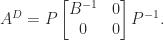
A^D = P \begin{bmatrix}                 B^{-1} & 0 \\                 0      & 0                 \end{bmatrix} P^{-1}.

Here is the pseudoinverse and the Drazin inverse for a particular matrix with index 2:

A = \left[\begin{array}{rrr} 1 & -1 & -1\\[3pt] 0 & 0 & -1\\[3pt] 0 & 0 & 0 \end{array}\right], \quad A^+ = \left[\begin{array}{rrr} \frac{1}{2} & -\frac{1}{2} & 0\\[3pt] -\frac{1}{2} & \frac{1}{2} & 0\\[3pt] 0 & -1 & 0 \end{array}\right], \quad A^D = \left[\begin{array}{rrr} 1 & -1 & 0\\[3pt] 0 & 0 & 0\\[3pt] 0 & 0 & 0 \end{array}\right].

Applications

The Moore–Penrose pseudoinverse is intimately connected with orthogonality, whereas the Drazin inverse has spectral properties related to those of the original matrix. The pseudoinverse occurs in all kinds of least squares problems. Applications of the Drazin inverse include population modelling, Markov chains, and singular systems of linear differential equations. It is not usually necessary to compute generalized inverses, but they are valuable theoretical tools.

References

This is a minimal set of references, which contain further useful references within.

Related Blog Posts

This article is part of the “What Is” series, available from https://nhigham.com/category/what-is and in PDF form from the GitHub repository https://github.com/higham/what-is.