Horace Lamb Portrait in Alan Turing Building

A portrait of Sir Horace Lamb (1849-1934), FRS, Beyer Professor of Pure and Applied Mathematics from 1888 to 1920, is on display on the Atrium bridge of the Alan Turing building in the School of Mathematics at the University of Manchester.

file://d:/dropbox/org/images/121031-1010-28_0595.jpg

This is the School’s common room, where we meet for morning coffee and lunch and which is the focal point of the School.

The 1913 portrait, approximately, 4 feet by 4 feet, is by Lamb’s son, Henry Lamb, a distinguished painter, and was presented to the University by Ernest Rutherford. It’s difficult to photograph due to reflections on the glass, so I took the photo from an angle.

Lamb made important contributions to many topics in applied mathematics, including waves, acoustics, elasticity, fluid dynamics, with applications to areassuch as seismology and the theory of tides. He is perhaps best known for his book Hydrodynamics, first published in 1879 (under the original title “Treatise on the Mathematical Theory of the Motion of Fluids”), which went through six editions. The second edition (1895) has been digitized by Google and can be downloaded from The Internet Archive.

The School’s main meeting room is named the Horace Lamb Room and contains an ornate writing desk and display cabinets presented to Lamb by the University of Adelaide, where he worked for nine year before moving to Manchester. The cabinets contain the engravings pictured below.
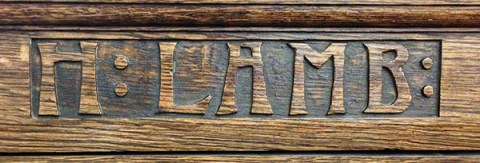

H. Lamb

A.D. 1898

The interesting story of how Lamb, born in Stockport near Manchester, came to take a chair in Adelaide, and why he subsequently returned to Manchester, is told in Horace Lamb and the Circumstances of His Appointment at Owens College by Brian Launder (2013).

For more about Lamb see The MacTutor History of Mathematics archive.
Fine-Tuning Spacing in LaTeX Equations

For several years I’ve been fine-tuning the spacing in LaTeX equations using a tip from Donald Knuth (the same tip works with TeX). He mentioned it in a question and answer session that he gave in 1996 in Holland and which is written up in Digital Typography (1999, p. 641). The idea, which he uses in The Art of Computer Programming, is to write

% Make @ behave as per catcode 13 (active).  TeXbook p. 155.
\mathcode`@="8000 
{\catcode`\@=\active\gdef@{\mkern1mu}}

Then within a formula the @ symbol acts as a macro that inserts 1mu of space. A mu is a math unit. For comparison, a thinspace,

\,

represents 3mu and a \quad 8mu.

Knuth gives the example \sqrt{@\log n} to produce the right amount of space before the l of log.

Some examples of my use of @ from my Functions of Matrices book are

\|@@|A^{-1}|@@\|_F
\sqrt{A}^{@@\pm 1}f(\sqrt{A})
f(uv^*) = f(0)I + f[v^*u,0] @@ uv^*
p_{km}(x) = \sum_{j=0}^k \frac{ (k+m-j)!@@ k! }{ (k+m)!@@ (k-j)! }

There aren’t really any rules; the use of @ is largely a matter of taste as to what looks right.

This level of fine-tuning is not something I do as a matter of course in drafts, or with any rigour in papers, but for a book I think it is well worth the effort.

Knuth also points out that $n^2/3$ looks better with a negative thin space, as $n^2\!/3$, so that there is less space between the superscript and the slash. On checking the LaTeX source I notice that I did this in my book, but had forgotten about it until I wrote this post!

SIAM Books on Google Play

In 2011 SIAM launched an institutional e-book program, which makes SIAM books available by chapter in PDF form for readers at subscribing institutions. As of late 2012, SIAM books are now available for individual e-book purchase from Google Play, for use on tablets, smartphones, e-readers, or computers (but not Kindles). Unlike in the institutional program, these e-books are subject to full digital rights management (DRM), which means users cannot copy them or print from them and only the Google account holder has access to the book.

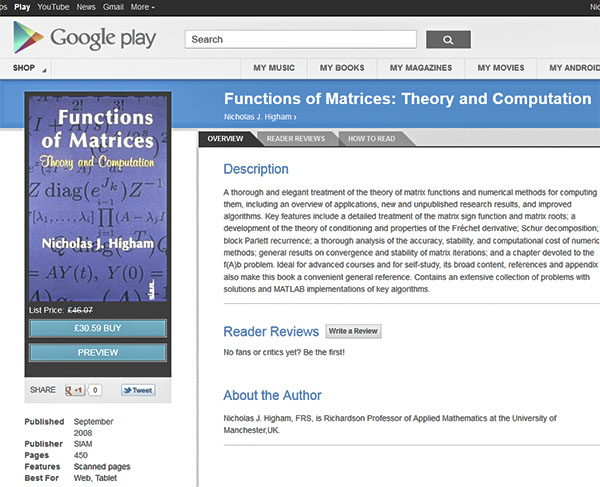
I’ve used the Preview facility to look at a few books on Google Play. My own SIAM books, such as Functions of Matrices (2008), are shown as “scanned pages” and appear to have been scanned from the hard copy; zooming in is supported.

file://d:/dropbox/org/images/google_play_FM.jpg

By comparison, the Princeton Companion to Mathematics can be viewed as “scanned pages” or “flowing text” (ePub format). In the latter, which reformats as you zoom in and seems to be the default, the mathematics renders poorly; this is a shame given the impeccable LaTeX typesetting of the original book.

Is there a good solution yet for how to render mathematics in e-books?

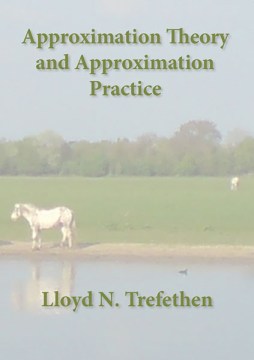
Trefethen’s Approximation Theory and Approximation Practice

This new 305-page SIAM book by Nick Trefethen presents a modern approach to approximation by polynomials and rational functions. Much of the theory here underlies the Chebfun software package and almost every page of the book contains examples computed using Chebfun.

file://d:/dropbox/org/images/tref12_cover.jpg

The book is certainly a must-read for anyone interested in numerical computation. But the most unusual feature of the book is not immediately obvious: it was entirely produced from 29 MATLAB M-files, one for each chapter. Each M-file contains the book’s text in comment lines intertwined with the MATLAB code that generates the examples and the figures. The book was created by using the MATLAB command publish to generate LaTeX output, which was then run through LaTeX (with a few tweaks for the actual printed book). Nick has made the M-files available at the book’s web page and you can generate the book by running them all through publish.

When I ran publish on one of the M-files it gave a strange error beginning

No method 'createTextNode' with matching signature found for class
'org.apache.xerces.dom.DocumentImpl'.

and I got the same error whatever M-file I tried to publish. This seems to be caused by a clash with some nonstandard M-file on my path, because if I reset the MATLAB path with the matlabrc command (and then add back chebfun to the path) everything works fine.